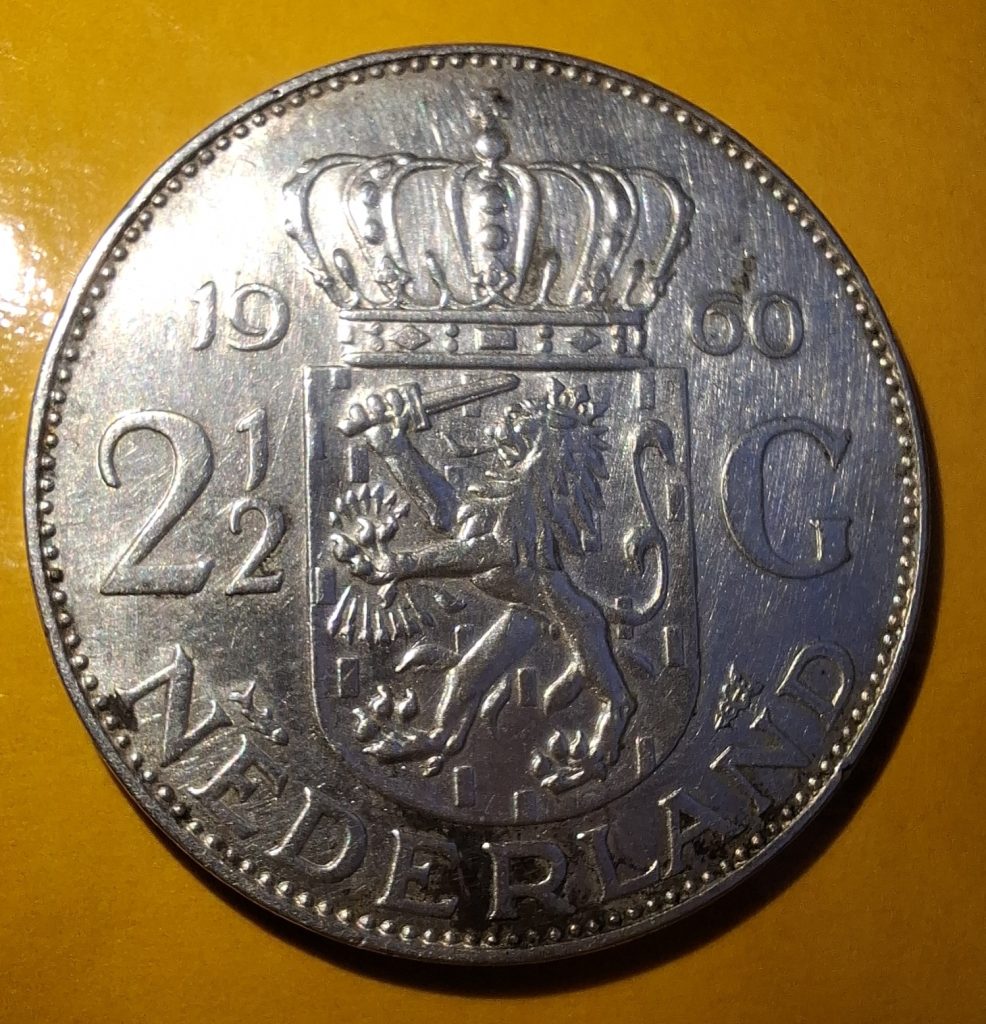
The 2½ Gulden coin minted in 1960 in the Netherlands is part of a series of circulating coins issued during the pre‑euro era. The obverse of the coin features the portrait of Queen Juliana of the Netherlands (reigned 1948–1980), facing right, with the inscription “JULIANA KONINGIN DER NEDERLANDEN.”
The reverse shows the crowned Dutch coat of arms, along with the denomination “2 1/2 G,” the country name “NEDERLAND,” and the year of minting, “1960.”
This coin is part of the series minted between 1959 and 1966.
Technical Specifications
- Denomination: 2½ Gulden (2.5 NLG)
- Composition: Silver 720/1000 (~ 72% silver, remainder copper)
- Gross weight: 15 grams
- Silver content: approx. 10.8 grams of fine silver
- Diameter: 33 mm
- Approximate thickness: ~2.3 mm
- Edge: Smooth with raised legend “★ GOD ★ ZIJ ★ MET ★ ONS ★” (“God be with us”).
- Catalog reference: KM #185 in numismatic catalogs.
The engraver responsible for the coin design — both the portrait of the queen and the reverse — was Dutch artist Ludwig Oswald Wenckebach.
Historical and Monetary Context
After World War II, Dutch currency underwent several changes: banknotes and coins wore out quickly, leading to the reintroduction of metal coins in the early 1950s.
The 2½ Gulden silver coin (“rijksdaalder”) began minting in 1959, featuring Queen Juliana’s portrait, and continued until 1966 — except in 1965, when no silver coin was issued.
The 720/1000 silver standard — common in mid-20th century coins — provided durability and intrinsic value, though with a relatively modest amount of fine silver per coin (about 10.8 g).
These coins were gradually demonetized, especially with the adoption of the euro in the Netherlands and the end of the gulden as national currency in 2002, although silver coins had already been phased out decades earlier.
Numismatic and Collector Value
The value of a 2½ Gulden 1960 coin depends on several factors: condition, strike quality, rarity (possible variants), and silver price. Market references include:
- In numismatic catalogs, coins in average condition (“XF” – Extra Fine) or slightly higher range between US$ 6.5 and US$ 15.
- Online sellers or collector shops list well-preserved coins at around €12–€20.
- Some sales or lots in exceptional condition (“proof-like”) can fetch higher prices — though these are less common.
The mintage for 1960 was about 12,800,000 coins, so this is not considered extremely rare. Its market value remains moderate unless in exceptional condition (uncirculated or proof).
For the average collector, this coin has more historical and collectible value than rarity. For silver investors, its intrinsic value is linked to the metal content — but with only 10.8 g of fine silver, it’s not ideal for large silver investments.
Why Collect the 2½ Gulden 1960?
- Tangible piece of Dutch monetary history and the pre-euro era — attractive for European coin collections.
- Classic design with artistic value — Queen Juliana’s portrait and national shield are historically and aesthetically significant.
- Suitable as a transition coin for collectors: not as expensive as rare coins but with enough value to preserve historical interest.
- Combines precious metal + historical denomination, making it appealing for collectors who value both history and metal content.