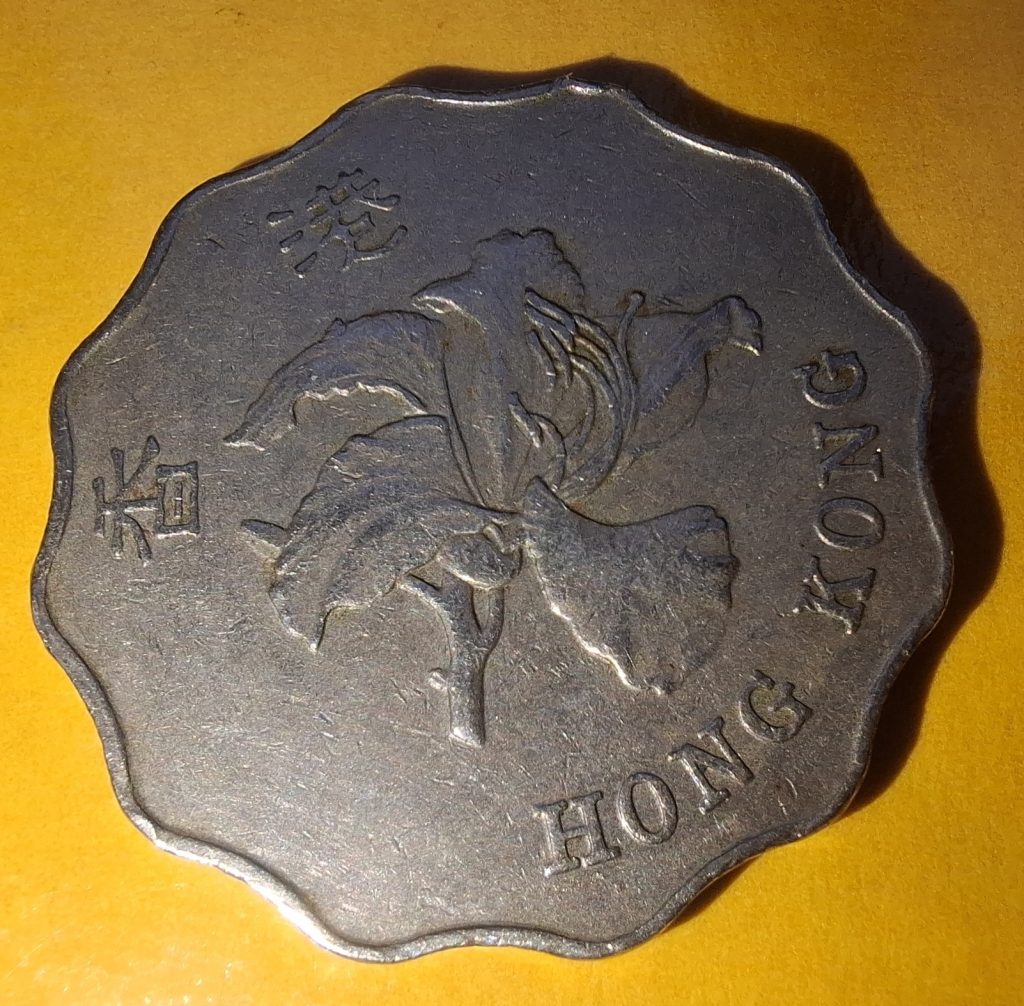
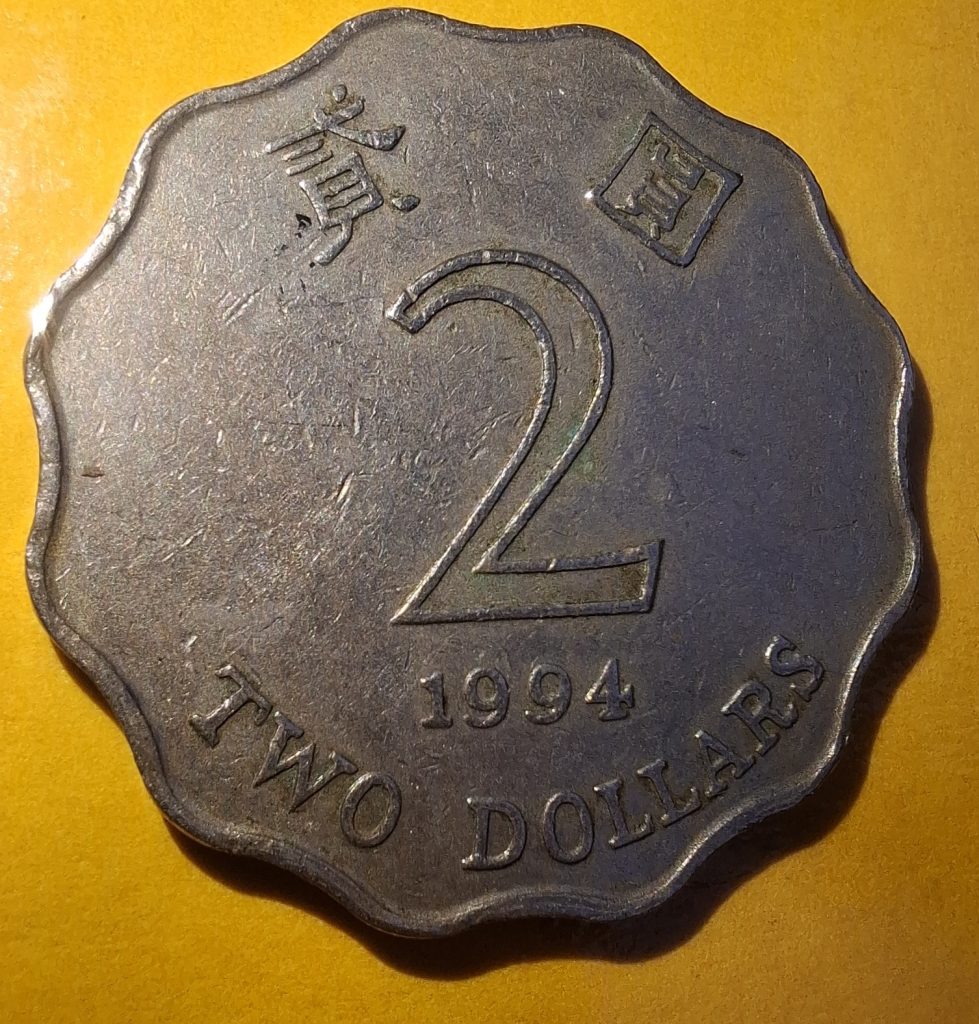
A regular-circulation coin from the Bauhinia series issued for Hong Kong after the replacement of Queen Elizabeth II’s portrait by the Bauhinia flower emblem. It is a common piece among collectors of Hong Kong coinage, but it remains interesting because of its design and its place in the pre-handover (1997) period.
Physical specifications and design
- Denomination: 2 dollars (HKD)
- Year: 1994
- Metal / composition: copper-nickel
- Weight: approx. 8.40 g
- Diameter: 28.0 mm (scalloped shape with 12 notches)
- Thickness: approx. 2.03 mm
- Edge: 12-scalloped design (a distinctive feature of the 2-dollar coin)
- Obverse: Bauhinia blakeana flower (symbol of Hong Kong) with the inscription “HONG KONG” in both English and Chinese — the Bauhinia design began appearing on circulation coins starting in 1993.
- Reverse: large numeral “2” and the inscriptions “TWO DOLLARS / 貳圓” indicating the denomination.
- Mint: many coins from this series were struck by the Royal Mint (Llantrisant, UK).
Historical and numismatic context
The Bauhinia series (with the flower on the obverse) replaced the obverse featuring Queen Elizabeth II in the early 1990s, as part of the political transition that would culminate with the 1997 handover. The scalloped 2-dollar coin became the standard circulation piece and continues to be used in later series (with year-to-year variations).
Information about the exact mintage figures for 1994 is incomplete in major catalogues; some guides list the mintage for certain years of the 1990s as “unknown.”
Condition and grading
- Circulated (Good–Very Fine): circulation marks, loss of original luster, contact scratches; design and legends remain readable.
- About Uncirculated (XF–AU): minimal wear on high points; better detail on the Bauhinia flower.
- Uncirculated / BU: retains original mint luster; noticeably higher value than circulated examples.
- Proof / presentation sets: less common for this denomination and year, but some annual presentation sets exist; proofs and special strikes command collector interest.
For accurate grading and valuation, third-party certification (NGC/PCGS) is recommended if the coin appears to be in high-grade uncirculated condition.
Numismatic and market value (guidance)
Market value varies significantly based on condition and demand, but here is a general guide:
- Common circulated examples: typically US$1–US$6.
- High-grade (AU / low MS): usually US$5–US$20, depending on luster and surface quality.
- Certified MS or special proof/presentation pieces: generally higher, though the standard 1994 circulation issue is not considered rare by itself.
Errors and varieties: like many coins, mint errors (double strikes, off-center strikes, planchet defects, etc.) can attract substantial premiums. Rare confirmed errors may reach hundreds or thousands of dollars, but these are exceptional cases and must be authenticated by specialists. The normal 1994 issue has no widely recognized rare variety.
How to evaluate your coin
- Examine it carefully: use a 5–10× loupe to inspect relief, edge, and possible errors.
- Take clear photos: obverse, reverse, edge, and any details of interest.
- Compare with catalogues: Numista, Krause (Standard Catalog / KM numbers), NGC World Coin Price Guide.
- Check real sale prices: look at completed listings on eBay or numismatic auction sites.
- Consider certification: if the coin is in exceptional condition or shows a possible mint error.
Where to buy or sell
- For fast, wide-reach sales: eBay or similar platforms (use clear photos and accurate descriptions).
- For high-value pieces: specialized numismatic auction houses or reputable dealers.
- For buying: choose sellers with strong reputation, return policies, and good photo documentation.
Final overview
The Hong Kong Two Dollars (1994) coin is a solid addition for collectors of modern Hong Kong currency: distinctive scalloped shape, attractive Bauhinia design, and part of an important historical transition period. Its standard market value is modest (a few dollars), but high-grade or error pieces can be worth significantly more.