The 1998 5 Rupees coin issued by the Reserve Bank of India (RBI) is a legal tender coin that belongs to the 5 Rupees series minted between 1992 and 2004, made of a copper-nickel alloy.
Technical Specifications
- Material: Copper-nickel (Cu + Ni), following the 1992–2004 series standard.
- Weight: 9.00 grams.
- Diameter: 23.00 mm.
- Shape: Circular; milled edge (reeded or plain depending on the coin variant).
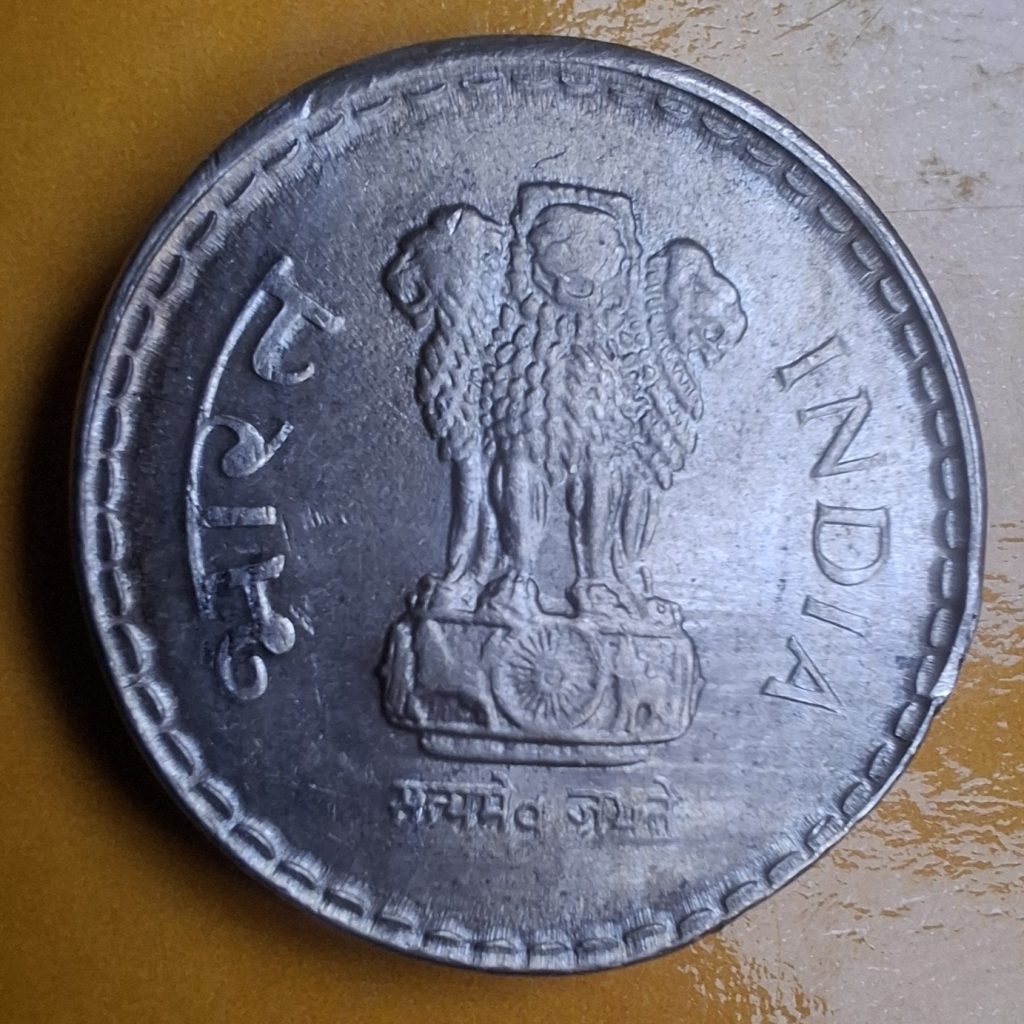
- Obverse (front): Often features the “Lion Capital of Ashoka” at the center, with inscriptions “भारत” (Bharat, in Hindi) and “INDIA” in English on each side; below is the motto “सत्यमेव जयते” (Satyameva Jayate, “Truth Alone Triumphs”).
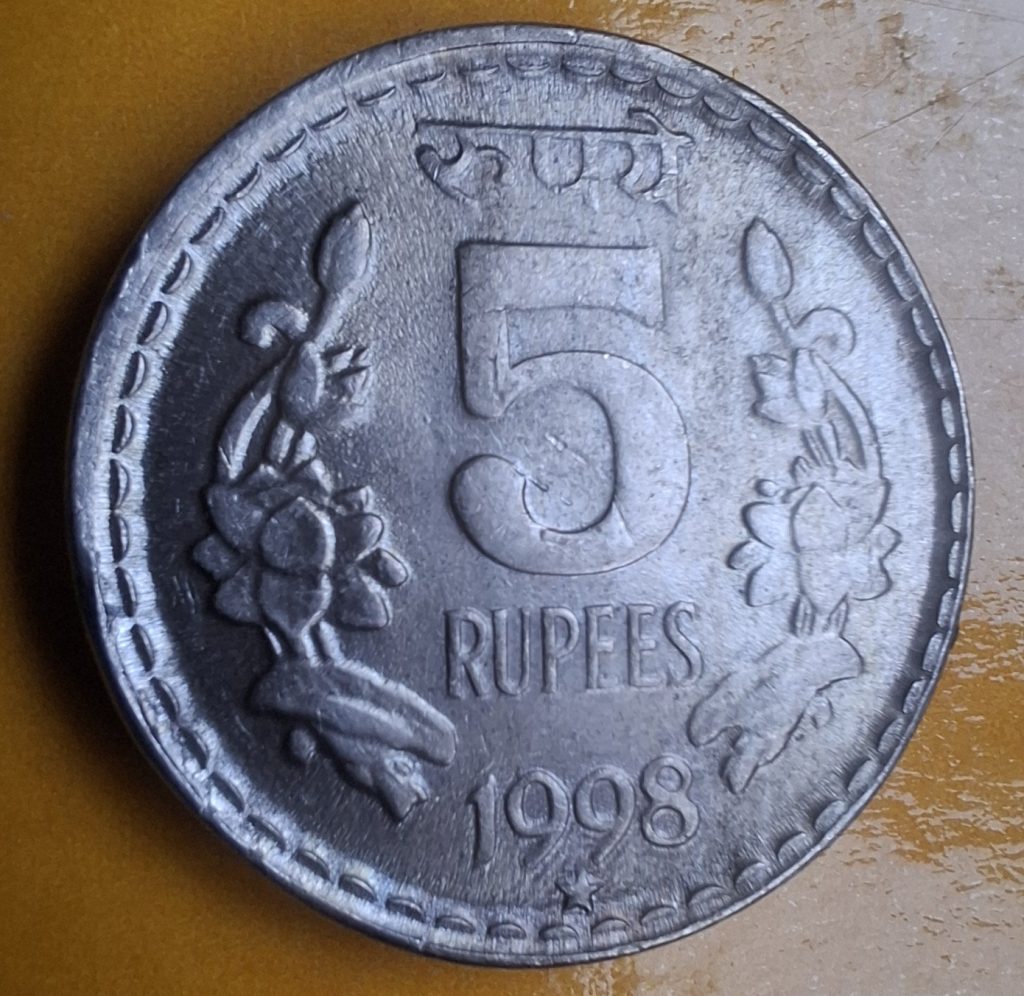
- Reverse (back): The numeral “5” at the center, with the word “Rupees” in English below; above, “रुपये” (Rupaye, “Rupees” in Hindi). At the bottom, the year “1998” and the mint mark (depending on mint: ♦ = Bombay/Mumbai; ☆ = Hyderabad; none = Kolkata/Calcuta). Floral ornaments, usually lotus-style, surround the value.
Mints
The 1998 5 Rupees coin was minted in different locations in India, such as:
- Bombay (Mumbai) — mark ♦ on some variants.
- Kolkata (Calcuta) — unmarked versions.
- Hyderabad — mark ☆ on some variants.
Some minor die variations are reported for 1998 and 1999 Bombay strikes, which can interest more serious collectors.
Historical and Monetary Context
The 5 Rupees series represents the period when India used copper-nickel coins for higher denominations before transitioning to cheaper alloys or other metals in later years.
The use of the “Lion Capital of Ashoka” on the obverse reflects India’s historical and cultural heritage. The motto “सत्यमेव जयते” (“Truth Alone Triumphs”) is part of the national emblem and appears on many coins and banknotes.
Hence, this coin is not only monetary but also a cultural artifact, making certain variants particularly interesting for collectors.
Numismatic Value and Collector Market
Although it was a common circulation coin, today the 1998 5 Rupees coin usually has modest numismatic value, but it is still sought after by collectors, especially in good condition or with interesting variants (such as different mint marks or die varieties).
- Typical market value ranges from about US$0.46 to US$1.16 depending on condition.
- In euros (depending on exchange rate), roughly €0.18 – €1.00 for common circulation coins.
- Well-preserved versions or rare local variants may fetch slightly higher prices at auctions or specialized sales, though it is not considered a “rare” coin.
Value depends heavily on coin condition (wear, scratches, relief sharpness), mint variant, and collector demand.
Factors Affecting Numismatic Interest
Key factors that can make the 1998 5 Rupees coin more or less appealing to collectors:
- Condition: uncirculated coins with sharp details are more valuable than worn coins.
- Mint/Mark Variant: different mints (Mumbai, Kolkata, Hyderabad) may be more interesting.
- Minting Errors/Die Varieties: as noted, Mumbai 1998/1999 coins have known variants; errors can increase value.
- Historical/Cultural Context: represents a specific phase of modern Indian 5 Rupees coins.
- Collector Demand: even common coins have value if they help complete a collection by year or mint variant.
Conclusion
The 1998 5 Rupees coin is a representative piece of modern Indian numismatics — simple in design but historically and culturally significant due to the national emblem. For collectors, its value lies more in completing collections, specific mint variants, or condition, rather than high monetary value.