The 2 Pfennig coin of 1924 is a small-denomination German coin issued during the Weimar Republic, the historical period following the First World War and preceding the Third Reich (1919–1933). Although modest in face value, it is of interest to collectors due to its historical context and its circulation after a period of severe monetary instability.
Historical Context
After the First World War and the hyperinflation crisis of 1922–1923, Germany introduced profound reforms to its monetary system. In 1924, coins were issued under the new Reichsmark system, which replaced the severely devalued Papiermark. The pfennig was the subdivision of the Reichsmark, with 100 pfennigs equaling one Reichsmark.
The inscription “Deutsches Reich” on the coin refers to the official name of the German state at the time. This designation was used both during the Weimar Republic and earlier periods and does not imply any association with later political regimes.
Technical Characteristics of the Coin
- Country: Germany – Weimar Republic
- Year of issue: 1924
- Denomination: 2 Pfennig (0.02 Reichsmark)
- Composition: Bronze
- Weight: approximately 3.3–3.34 g
- Diameter: about 20–20.2 mm
- Edge: smooth
- Alignment: medal alignment
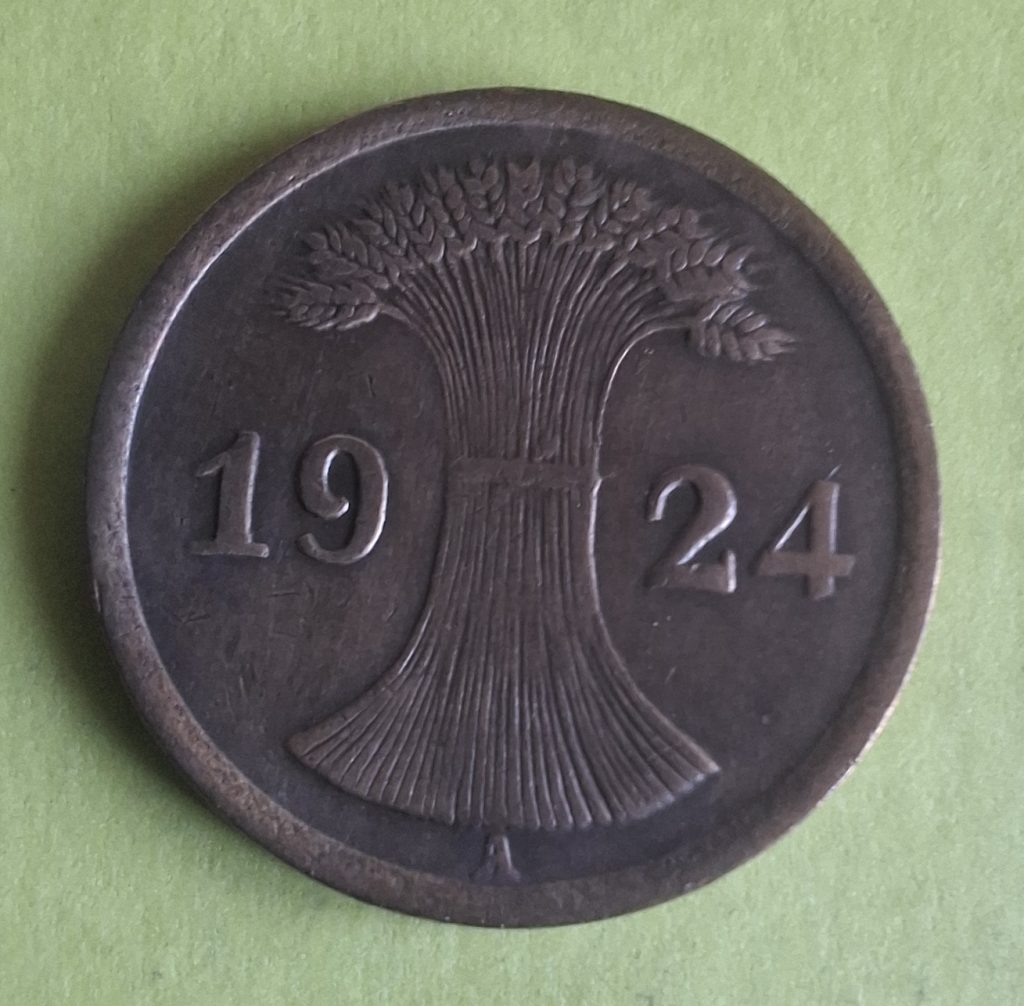
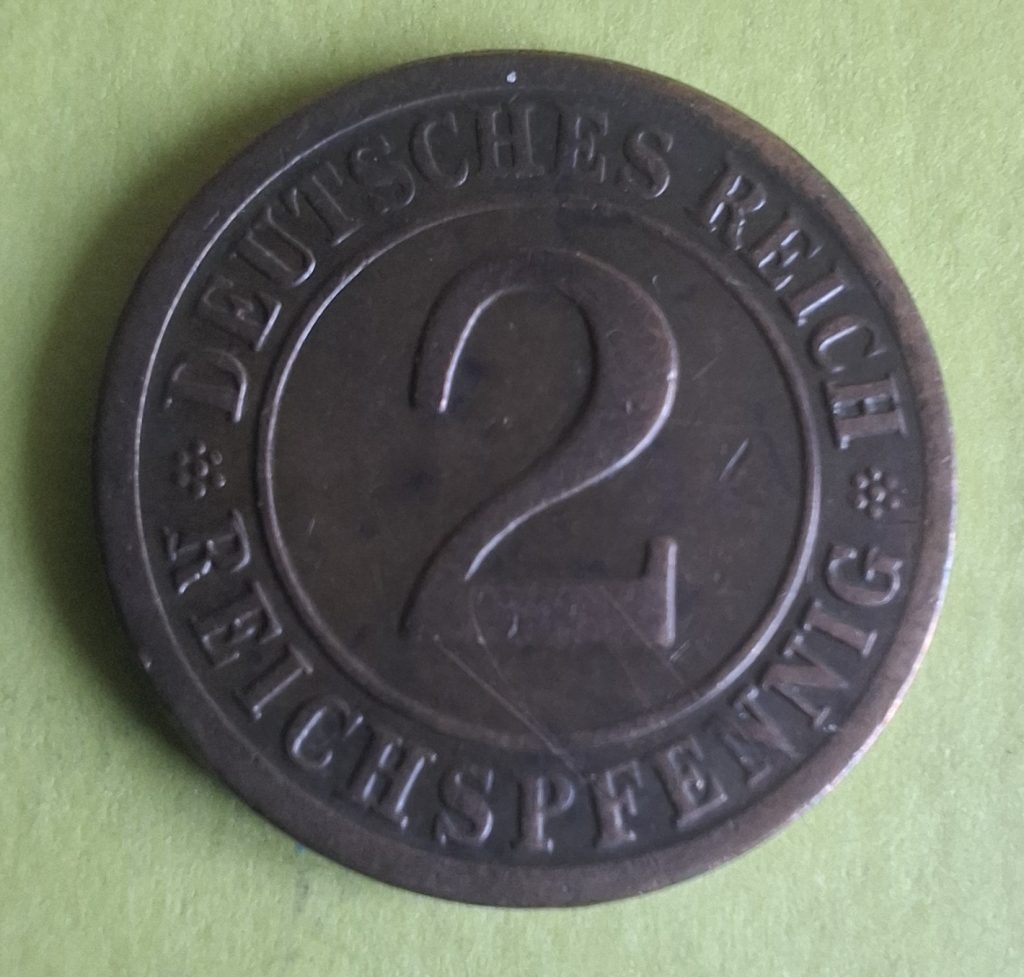
The obverse bears the denomination and the inscription “DEUTSCHES REICH 2 REICHSPFENNIG”, while the reverse shows the year of issue surrounded by stylized ears of wheat, a common agricultural motif of the period. The coin was designed by engraver Reinhard Kullrich.
Mintmark Variants
The 2 Pfennig coin of 1924 exists with several mintmarks, indicated by a letter identifying the mint of origin:
- A – Berlin
- D – Munich
- F – Stuttgart
- G – Karlsruhe
- J – Hamburg
Each mint produced different quantities. Some, such as Berlin and Hamburg, struck millions of coins, while others had comparatively lower mintages, which can influence collector interest.
Numismatic Value
The market value of a 2 Pfennig 1924 coin depends mainly on its state of preservation, the specific mintmark, and collector demand. Common examples in circulated condition typically sell for around €0.50 to €1.75. Coins in higher grades, especially those with minimal wear, may command higher prices.
In private sales or online listings, well-preserved specimens are sometimes offered for €10–15 or more, although such prices depend heavily on condition, authenticity, and the specific market context.
Demonetization and Collecting Interest
Small-denomination pfennig coins were demonetized long after they ceased to have practical use in daily commerce. Today, they no longer hold legal tender status and are collected primarily for their historical and numismatic significance.
In summary, the 1924 2 Pfennig coin represents a tangible piece of Germany’s post–First World War economic history. For collectors, it offers an accessible entry into Weimar Republic coinage, combining historical relevance with modest numismatic value.