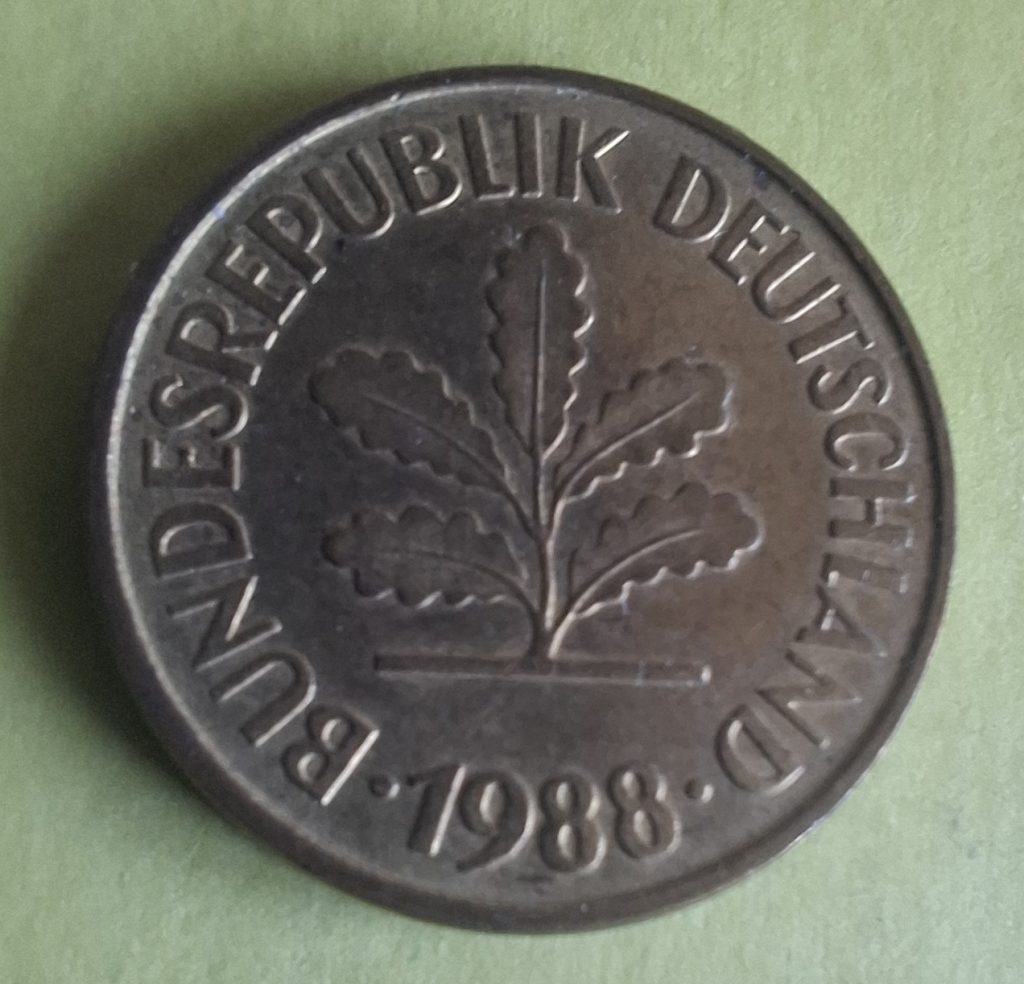
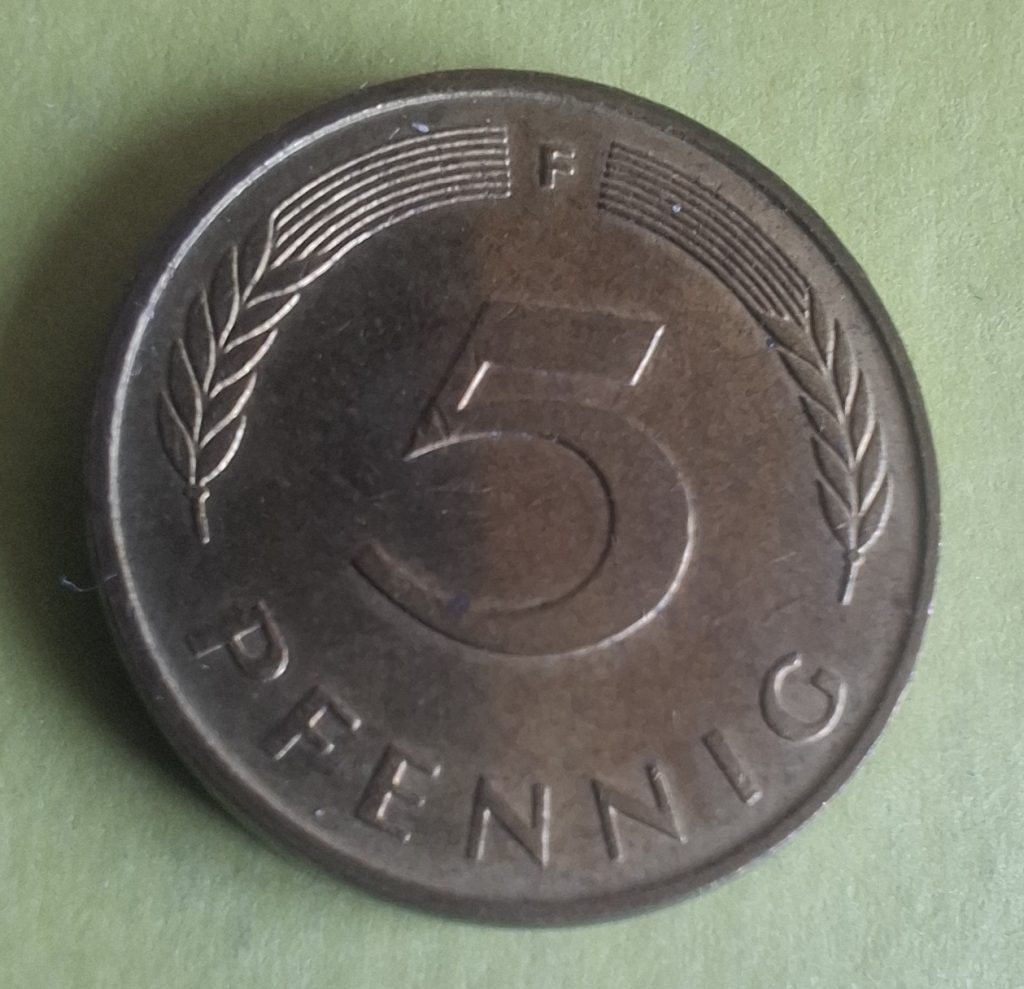
The 1988 5 Pfennig coin was issued by the Federal Republic of Germany (Bundesrepublik Deutschland) as part of the circulating coinage of the former German mark (Deutsche Mark), the national currency prior to the introduction of the euro in 2002.
Historical background
The pfennig was the subdivision of the German mark, with 100 pfennigs equaling one mark. Coins of this denomination were widely used in everyday transactions for small purchases. During the 1970s and 1980s, the 5 Pfennig coin was produced in very large quantities, reflecting its practical role in daily economic life in West Germany and later in a reunified Germany.
Design and physical characteristics
Obverse
The obverse bears the inscription “BUNDESREPUBLIK DEUTSCHLAND” (Federal Republic of Germany) along with the year of minting, 1988. Below the inscription appears an oak sapling with five leaves, a traditional German symbol representing strength, endurance, and national heritage.
Reverse
The reverse displays the denomination “5 PFENNIG”, framed by two ears of grain. Above the denomination is the mint mark, represented by a letter identifying the mint where the coin was struck:
- D – Munich
- F – Stuttgart
- G – Karlsruhe
- J – Hamburg
Composition and specifications
The 5 Pfennig coin of this period was made of brass-plated steel, giving it a golden appearance while keeping production costs low. It has a diameter of approximately 18.5 mm and a weight of about 3 grams, typical for low-denomination circulating coins.
Mintages and mint varieties
Each mint produced its own version of the coin, resulting in several variants:
- D (Munich): tens of millions of coins minted
- F (Stuttgart): usually the highest mintage among the variants
- G (Karlsruhe): generally lower mintage, making it slightly more desirable to collectors
- J (Hamburg): common circulation issue
While all variants have the same face value, differences in mintage can influence collector interest.
Numismatic value
As a mass-produced circulation coin with no precious metal content, the 1988 5 Pfennig has a modest numismatic value. Its worth depends mainly on the mint mark and condition:
- Common variants (especially F and J) in circulated condition typically sell for around 0.30 to 1 USD.
- The G mint variant may reach higher values, sometimes up to about 5 USD in very fine or uncirculated condition.
- Heavily worn examples usually have minimal collector value.
Minting errors or exceptional preservation can increase value, but such cases are uncommon and usually require expert verification.
Conclusion
The 1988 5 Pfennig coin is a representative example of everyday German coinage before the euro era. While it does not command high prices on the numismatic market, it remains an interesting historical artifact that reflects the economic life and design aesthetics of late 20th-century Germany. Well-preserved examples and lower-mintage variants continue to attract collectors with an interest in modern German numismatics.