Introduction and Historical Context
The 100 Escudos coin from 1989 belongs to Portugal’s Second Series of Portuguese Discoveries, a commemorative series celebrating key moments of the Age of Discoveries.
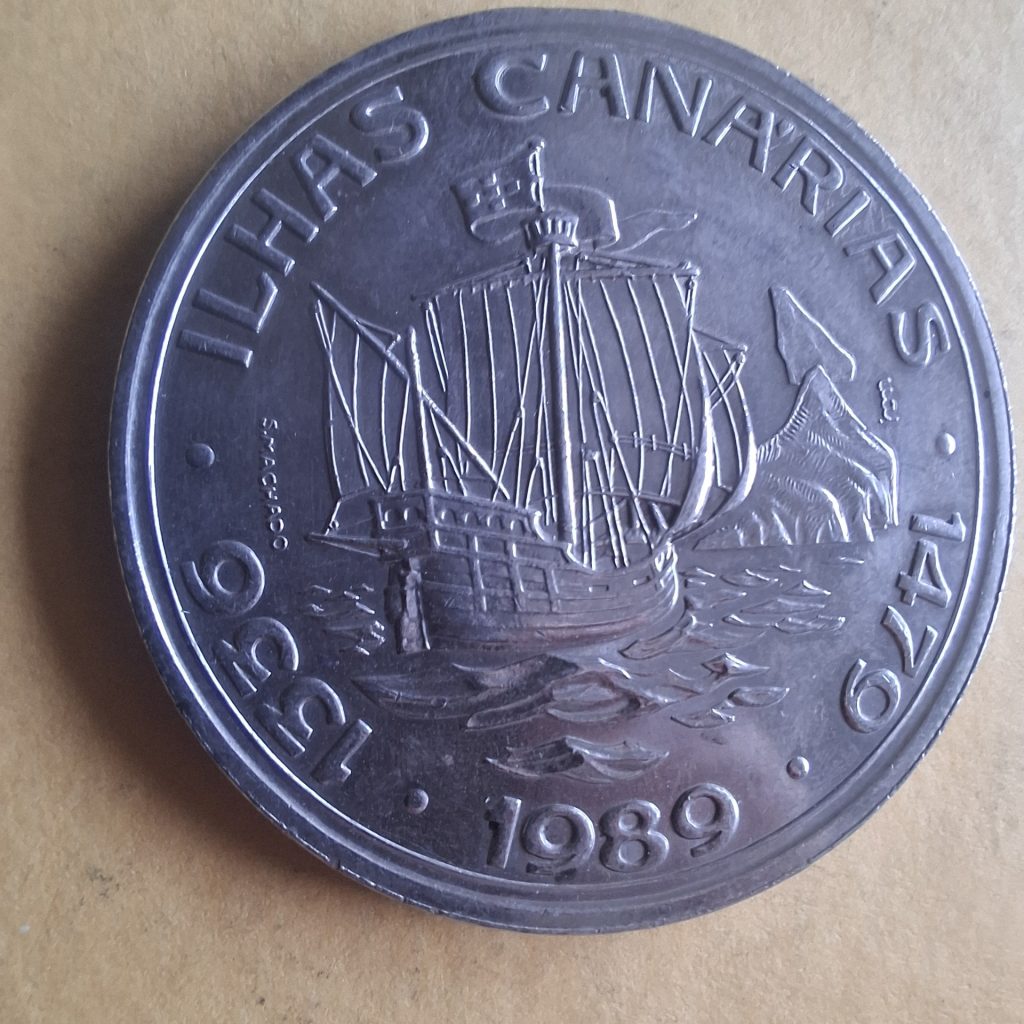
This particular coin honors the “discovery” of the Canary Islands by the Portuguese, marked with the dates 1336 (year of Portuguese discovery) and 1479 (date of return or settlement with Spain).
The theme reflects Portugal’s historical interest in Atlantic expansion and past territorial claims between European kingdoms.
Coin Features
Design and Engraving
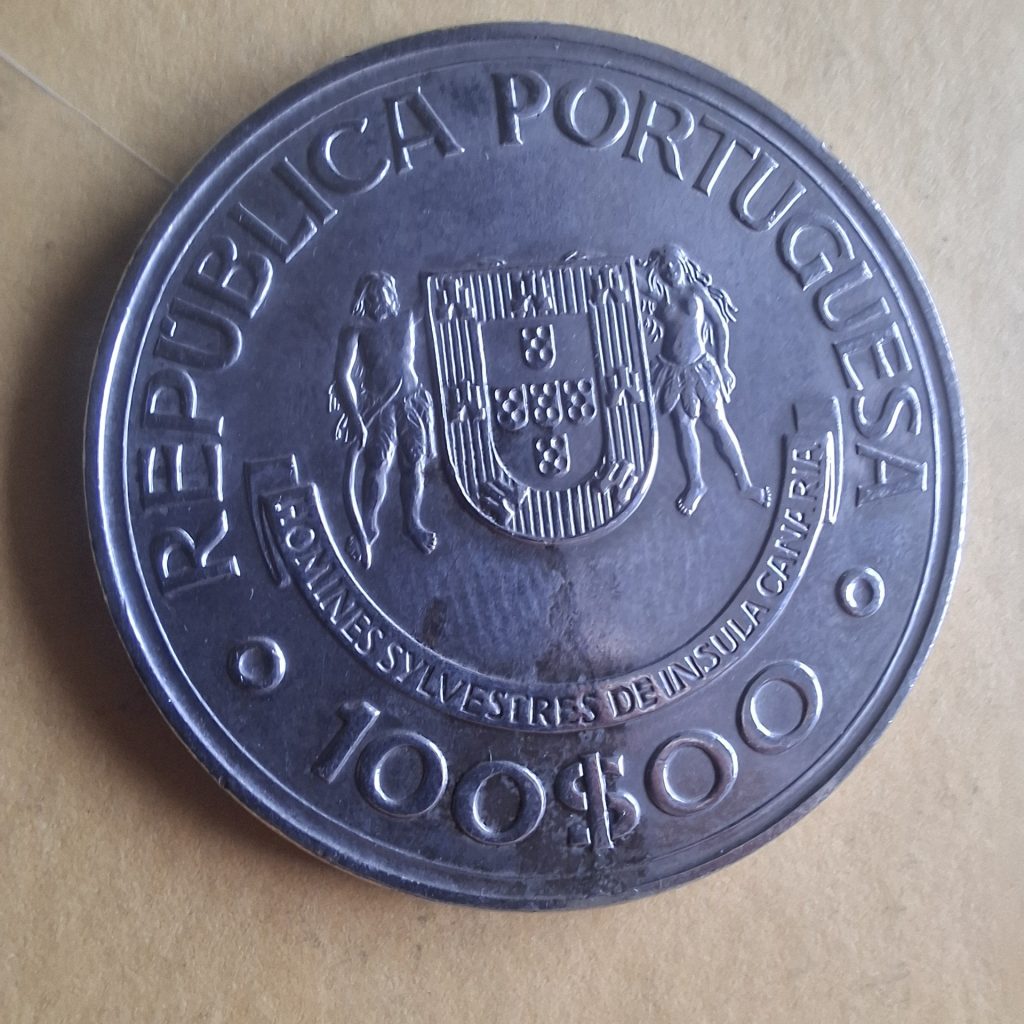
- Obverse: Features the Portuguese coat of arms flanked by two Guanche figures (original inhabitants of the Canary Islands), representing the pre-European population. Below is the Latin inscription: “HOMINES SYLVESTRES DE INSULA CANARIA”.
- Reverse: Shows a caravel (a typical sailing ship of the Discoveries) sailing in front of the Canary Islands. To the left of the caravel: “1336 · ILHAS CANARIAS”; to the right: “1479”, with the engraver’s signature (“S. Machado incm”) and the year of minting, 1989.
- Engraver: Raúl de Sousa Machado.
Dimensions and Material
- Composition: Cupronickel (copper-nickel alloy)
- Weight: approx. 16.5 g
- Diameter: 34 mm
- Thickness: approx. 3 mm
- Edge: reeded
- Orientation: ↑/↓ (obverse and reverse are 180° rotated)
- Mint: Imprensa Nacional – Casa da Moeda, Lisbon
- Demonetized after the adoption of the euro.
Mintage
- Cupronickel version: 2,000,000 coins minted
- Other variants:
- Silver PROOF version (much lower mintage)
- Gold PROOF version (rare)
Symbolic Significance
- The inscription “HOMINES SYLVESTRES DE INSULA CANARIA” reflects how European colonizers viewed the original inhabitants (Guanche), often depicted as “wild.”
- The caravel represents Portuguese maritime exploration and Atlantic expansion.
- Dates 1336 and 1479 recall diplomatic and territorial events: Portuguese “discovery” and subsequent Spanish affirmation over the islands.
Numismatic Value
Circulating / Common Coins
- Cupronickel coins in good condition are moderately priced: around €5–€12, depending on condition and seller.
- Proof coins in silver or gold are much more valuable, ranging from hundreds of euros for silver to significantly higher for gold.
Collector Interest
- Cupronickel coins are common due to high mintage, making them easy to acquire.
- Silver and gold proofs are rarer, attracting serious collectors and potential appreciation.
- Historical significance adds thematic value for collectors of Portuguese Discoveries or maritime history.
Care for Collectors
- Verify condition: circulated coins are worth less than “Uncirculated” or Proof coins.
- Confirm the variant: cupronickel, silver proof, or gold, as value varies greatly.
- Store in a capsule or numismatic holder to preserve quality.
Conclusion
The 100 Escudos Canary Islands 1989 coin is historically rich, reflecting Portugal’s era of discoveries and connection to the Canary Islands. Technically well-made (cupronickel, detailed design), it is accessible for casual collectors. Silver and gold proofs provide rarer, high-value options for serious collectors.