The 1924 10 Rentenpfennig coin was issued by Germany during the Weimar Republic, a period of transition and economic challenges following World War I. This coin is part of the monetary system based on the Rentenmark, introduced to stabilize the German economy after the hyperinflation that had severely devalued the currency in the early 1920s. The Rentenmark, backed by real assets, effectively replaced the inflated Reichsmark.
Physical characteristics and design
The coin is made of aluminum-bronze, weighs approximately 3.92 g, and has a diameter of 21 mm. It features a reeded edge and medal alignment (both sides upright).
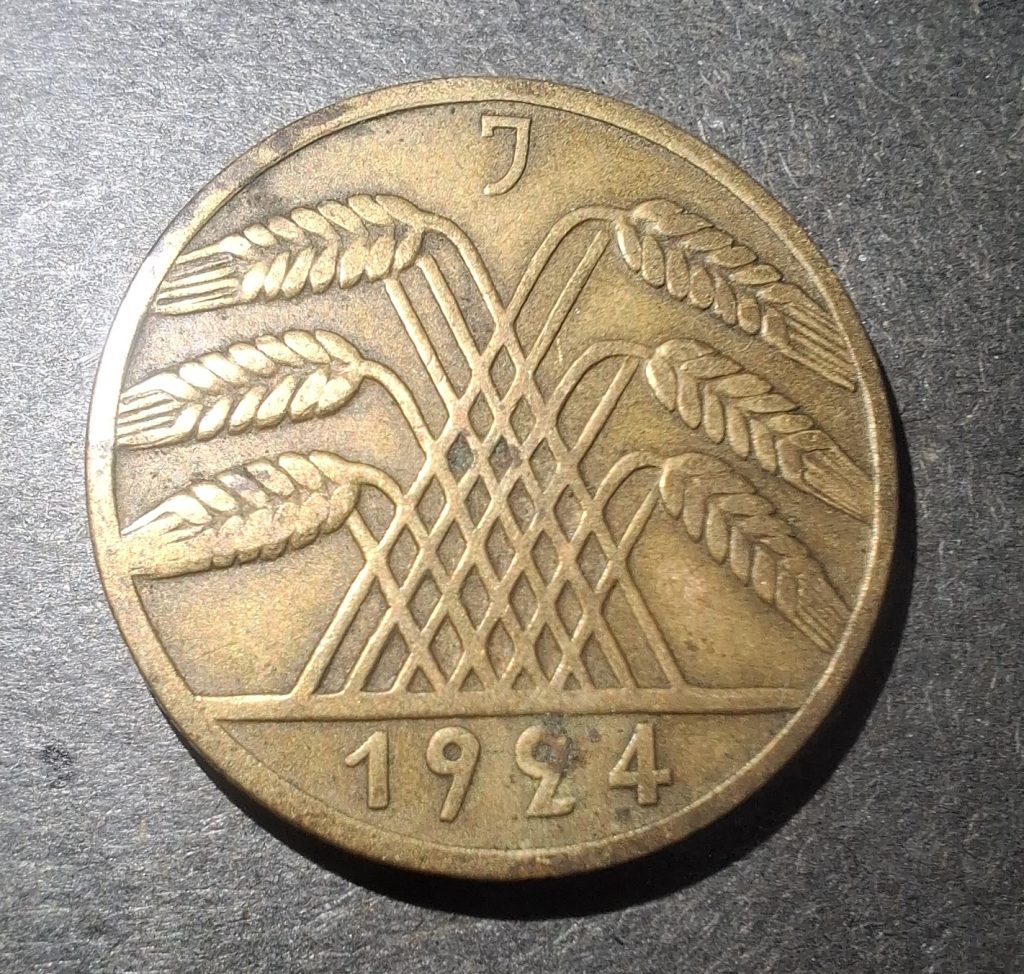
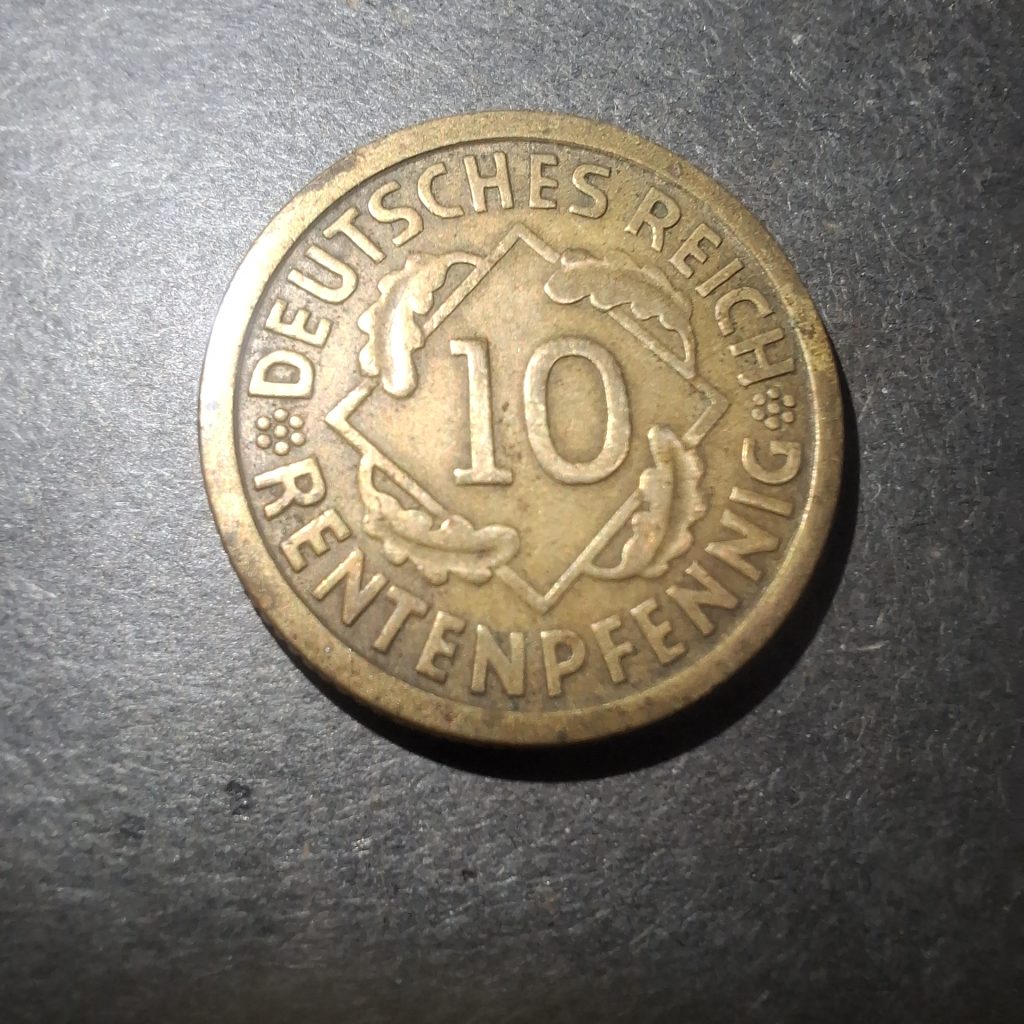
On the obverse, the denomination “10 RENTENPFENNIG” appears inside a square surrounded by four oak leaves, a traditional symbol of strength and stability. The inscription “DEUTSCHES REICH” indicates the issuing country. The reverse shows ears of wheat arranged in a pyramid shape, with the mint mark (for example, A, D, E, F, G, or J) above the date “1924.” The coin was designed by Waldemar Raemisch.
Historical context
The coin was issued during a time when Germany was recovering from the post-World War I hyperinflation crisis. The Rentenmark was created in 1923 as a transitional currency backed by real assets, with the Rentenpfennig as its decimal subdivision (1/100 of a Rentenmark). This coin circulated only for a few years (approximately 1923–1925) before the Reichsmark system was fully established.
Mints and variants
The 1924 coin was minted in several German mints, each identified by a mint mark letter:
- A – Berlin
- D – Munich
- E – Muldenhütten
- F – Stuttgart
- G – Karlsruhe
- J – Hamburg
These variants differ in rarity and, consequently, numismatic value.
Numismatic value
The value of a 1924 10 Rentenpfennig coin depends mainly on condition (grade), mint variant, and special features such as patina, strike quality, or wear.
- Common coins in circulated condition (Good to Very Fine) typically sell for just a few euros/dollars in standard markets.
- Coins in higher grades (Extremely Fine or Proof) can fetch higher prices, especially rarer mint variants sought by collectors.
Recent auction data suggest that 1924 “A” (Berlin) coins have moderate prices, while 1924 “G” (Karlsruhe), with lower mintages, command higher prices in excellent condition. Even rarer varieties usually do not reach extremely high values unless in exceptional grades or certified by recognized grading services.
Collector significance
For numismatists, the 1924 10 Rentenpfennig is an important example of Germany’s post-war monetary transition. While it may not be highly valuable individually, its historical significance—especially in collections representing the Weimar Republic—is notable. Mint mark variations and mintage studies also make it interesting for thematic collections or complete series of early 20th-century German coins.