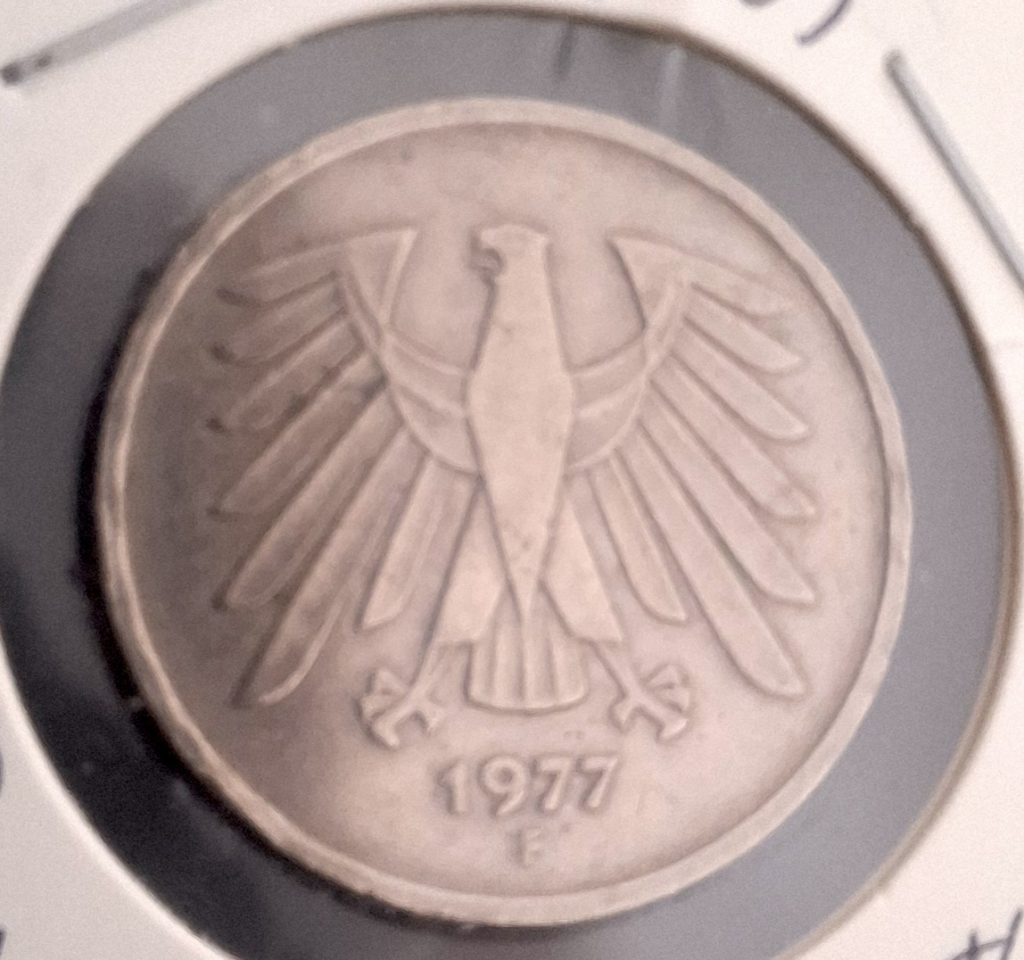
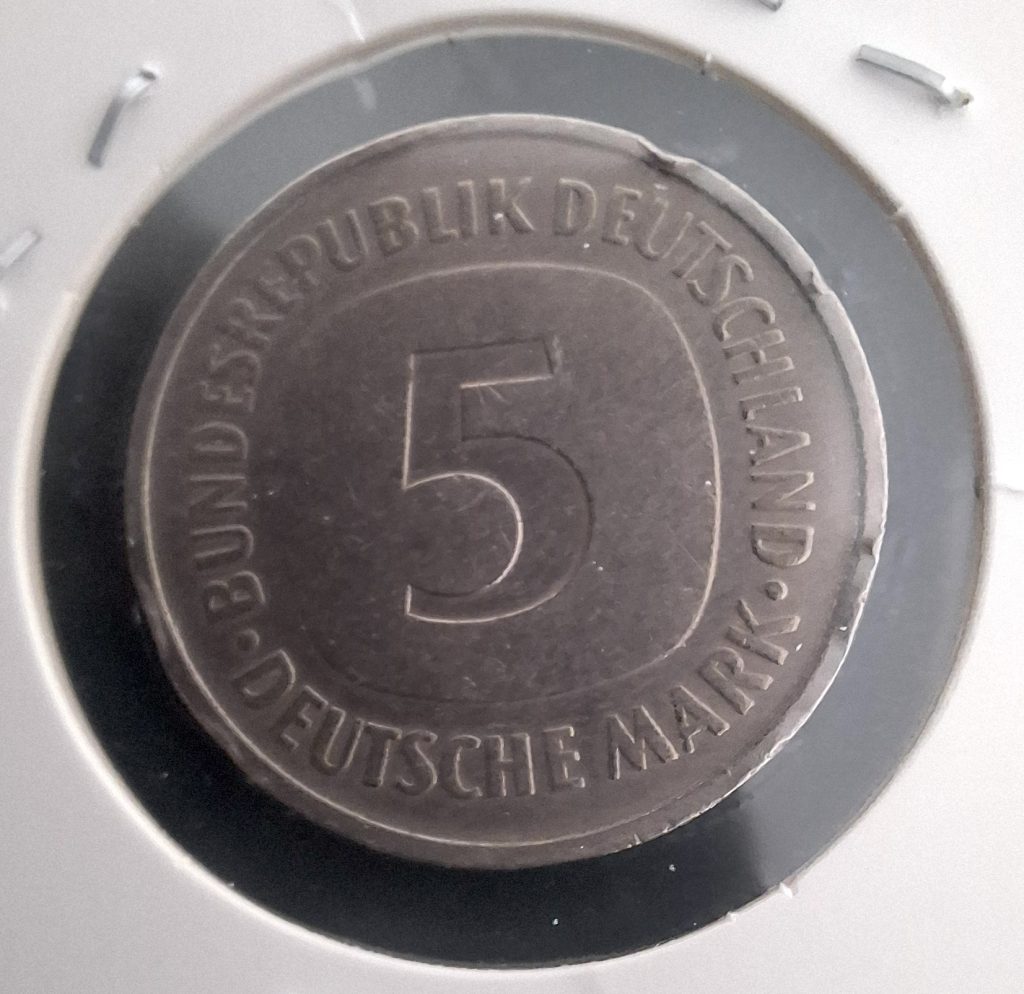
The 5 Mark coin issued in Germany in 1977 belongs to the period of the Federal Republic of Germany (West Germany), when the Deutsche Mark was one of the strongest and most respected currencies in Europe. These coins became popular among collectors because of their high minting quality, historical themes, and in some cases, their silver content.
In 1977, several commemorative 5 Deutsche Mark coins were issued, especially those dedicated to the mathematician and scientist Carl Friedrich Gauss and the writer Heinrich von Kleist.
Technical Characteristics
The commemorative version dedicated to Carl Friedrich Gauss has the following specifications:
- Face value: 5 Deutsche Mark
- Country: Germany
- Year: 1977
- Composition: 625‰ silver and 375‰ copper
- Weight: 11.2 grams
- Diameter: 29 mm
- Pure silver content: approximately 7 grams
- Lettered edge
- Medal alignment
- Withdrawn from circulation after the introduction of the euro in 2001
On the obverse of the coin appears the German federal eagle together with the inscription “Bundesrepublik Deutschland” and the face value. On the reverse is the portrait of Carl Friedrich Gauss with the dates “1777–1855.” The design was created by engraver Erich Ott.
Historical Context
During the 1950s, 1960s, and 1970s, West Germany produced several 5 Mark silver coins. These coins were known for their excellent quality and circulated widely in everyday commerce.
The 1977 issue honoring Gauss celebrated the 200th anniversary of the birth of the famous German mathematician, considered one of the greatest scientists in history. The coin also reflects Germany’s tradition of using numismatics to preserve the cultural and scientific memory of the nation.
Besides the Gauss version, other commemorative issues from 1977 honored German cultural figures such as Heinrich von Kleist.
Mint Marks
German coins of this era were struck at different mints identified by letters:
- A — Berlin
- D — Munich
- F — Stuttgart
- G — Karlsruhe
- J — Hamburg
The mint letter usually appears near the date on the coin. Some mints produced lower quantities, making certain varieties more desirable to collectors.
Current Numismatic Value
The value of a 5 Mark coin from 1977 mainly depends on:
- Condition and preservation
- Mint mark
- Market demand
- Silver content
- Presence of original packaging or proof quality
Common circulated examples are generally worth between 2 and 10 euros. Coins in uncirculated condition or proof versions may exceed 40 or 50 euros.
The silver versions also carry intrinsic metal value. Their approximately 7 grams of pure silver provide a minimum value linked to the precious metals market.
Certain low-mintage varieties can achieve even higher prices in specialized auctions, especially when certified by professional grading companies.
Interest Among Collectors
These coins are highly appreciated by European collectors for several reasons:
- Elegant and detailed design
- Historical connection to post-war Germany
- Commemorative themes featuring historical figures
- Silver composition
- Strong availability in the collector market
Many numismatists consider the 5 Deutsche Mark series among the most beautiful European coins of the 20th century.
Conclusion
The German 5 Mark coin of 1977 represents an important historical piece from former West Germany. Beyond its original monetary value, it has become a sought-after numismatic collectible thanks to its silver content, cultural significance, and artistic minting quality.
While many varieties remain relatively affordable, rare and well-preserved specimens can reach impressive prices in the collectors’ market. For enthusiasts of historical European coinage, this issue remains an excellent addition to any collection.