Introduction and Historical Context
The New Zealand two-dollar coin ($2 NZD) is the highest-value denomination currently in everyday circulation among the country’s coins.
Originally, there was a two-dollar banknote in New Zealand’s monetary system — introduced in 1967, when the country adopted the dollar, and withdrawn in 1991, when it was replaced by the coin.
The two-dollar coin was first issued in 1990, alongside the one-dollar coin, to replace lower-denomination notes, reduce printing costs, and make the monetary system more efficient.
Since its introduction, the coin has remained in continuous circulation, undergoing minor design changes (mainly in the Queen’s portrait) and some special or variant issues.
Technical Specifications and Design
| Feature | Value / Description |
|---|---|
| Denomination | 2 New Zealand dollars |
| Composition / Material | Aluminium-bronze alloy |
| Weight | 10.00 g |
| Diameter | 26.5 mm |
| Thickness | 2.7 mm |
| Edge | Fully reeded with an incuse channel containing 10 raised dimples |
| Orientation | Medal alignment (↑↑) |
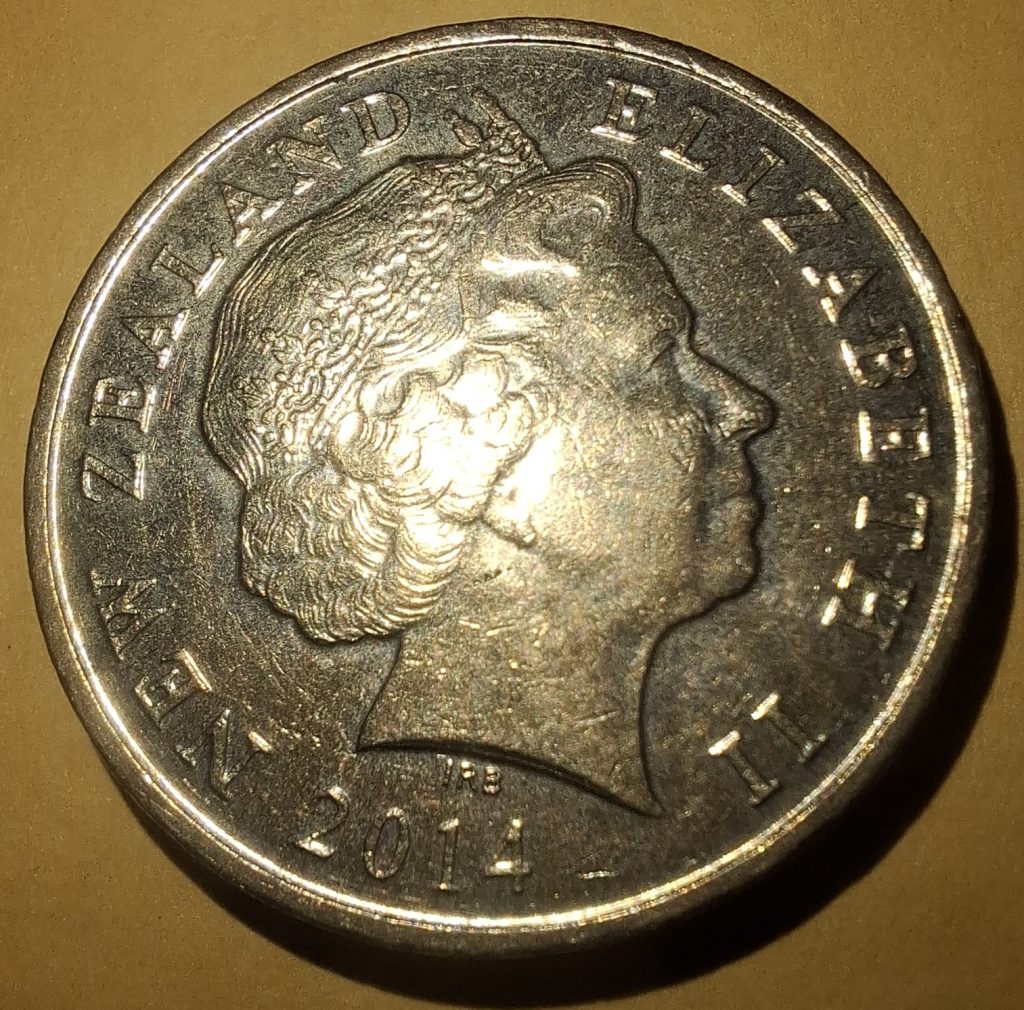
Obverse (front)
- From 1990 to 1998, the obverse featured the third crowned portrait of Queen Elizabeth II, facing right and wearing the King George IV State Diadem.
- The inscription read “ELIZABETH II NEW ZEALAND”, with the date below.
- In 1999, a new portrait by sculptor Ian Rank-Broadley was introduced, with the text repositioned to read “NEW ZEALAND ELIZABETH II”.
Reverse (back)
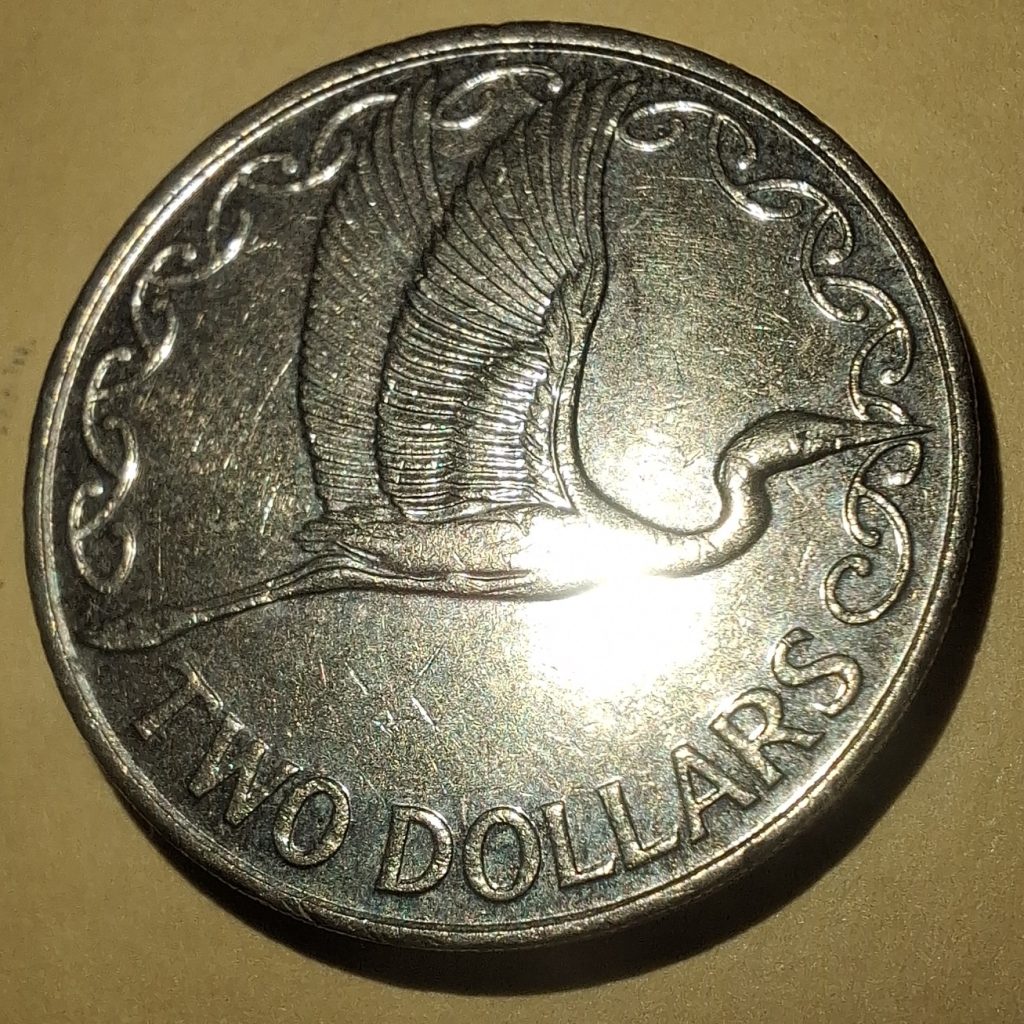
- The reverse depicts the white heron (kotuku in Māori), a bird that holds great symbolic value in New Zealand culture.
- Around the kotuku is a decorative border inspired by traditional Māori art.
- The denomination “TWO DOLLARS” appears at the bottom.
The choice of the kotuku — a rare and revered bird in Māori tradition — reinforces the connection between the coin and New Zealand’s national identity.
Production, Mintages, and Curiosities
Main Mintages and Variants
- The two-dollar coin has been minted continuously since 1990, with varying production volumes depending on the year.
- An interesting fact: the 1997 issue was withdrawn from circulation because it had a slightly different metallic composition, which caused vending machines and parking meters to reject it due to changes in electrical conductivity.
- Later series featuring the Rank-Broadley portrait (from 1999 onward) are listed in numismatic catalogs with detailed mintage estimates.
Issuing Authority and Mints
- The coin is officially issued by the Reserve Bank of New Zealand (RBNZ).
- Over the years, production has been carried out by various mints, including the Royal Australian Mint and others.
Future Developments: The Transition to King Charles III
Following the passing of Queen Elizabeth II in 2022, the RBNZ has announced that future coins will eventually bear the portrait of King Charles III, though this change will only occur once existing stocks of coins featuring the late Queen’s effigy are depleted.
Numismatic Value
The numismatic value of a New Zealand two-dollar coin depends on several factors, including condition, year, rarity, presence of variants or minting errors, and collector demand.
Typical Value Ranges
- Circulated coins (low or medium grade) are usually worth only slightly above face value.
- Uncirculated (UNC) or Brilliant Uncirculated (BU) examples can be worth significantly more, especially in proof sets.
- Rare issues, variants, or error coins (such as misaligned dies or unusual edges) often command premium prices in auctions.
For example, the NGC catalog lists the KM#121 series (from 1999 onward) with values that vary according to year and condition (proof, BU, or circulation).
Earlier coins from 1990–1998 (KM#79) are also catalogued, with corresponding valuations by grade.
A notable case: 1997 coins, withdrawn due to the metal composition issue, are of particular interest to collectors — though many were destroyed.
Example Case
A 2002 $2 NZD coin in BU condition may sell slightly above face value if well preserved.
Meanwhile, a 1990 issue in uncirculated (UNC) condition can be more desirable, even if not extremely rare. Catalogs (such as Krause’s Standard Catalog of World Coins) provide estimated prices that depend on preservation and demand.
However, it’s important to note: catalog prices are only average estimates. The real market value depends on the buyer, the auction venue, the seller’s reputation, and the coin’s specific condition.
Factors That Influence Value
Collectors should consider the following aspects when evaluating a New Zealand two-dollar coin:
- Condition / Grade – Coins with sharp details and no wear or scratches are far more valuable.
- Year / Mintage – Lower mintage years or special editions are more sought after.
- Variants or Errors – Coins with minting flaws or irregularities often attract premium interest.
- Certification – Grading by professional services like NGC or PCGS increases trust and value.
- Market Demand – Designs with strong cultural or symbolic appeal (like the kotuku) tend to be more liquid.
- Authenticity – Counterfeits or reproductions drastically reduce value; verified authenticity is key.
Final Considerations
The New Zealand two-dollar coin blends everyday practicality with cultural and symbolic richness, featuring both national motifs (the kotuku) and royal iconography (Queen Elizabeth II, and soon King Charles III).
For collectors, even though its face value is modest, certain years, conditions, and variants make it a fascinating and collectible piece.
When buying or appraising one, always examine condition, rarity, and consider professional certification for added confidence in authenticity and value.