Introduction
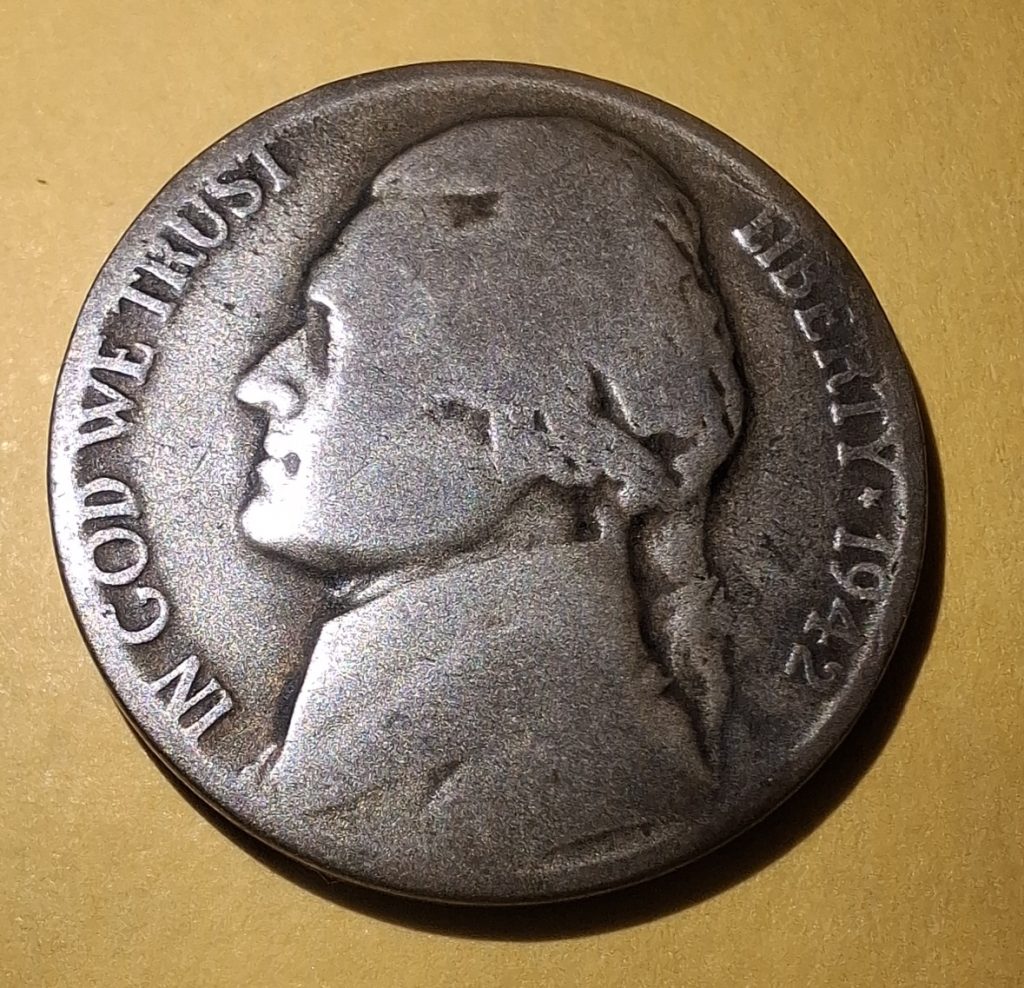
In 1942, during World War II, the United States temporarily changed the composition of the 5-cent coin (Jefferson nickel) to conserve nickel, a metal that was in high demand for war production. Coins minted between 1942 and 1945 with an alloy containing silver are known as “War Nickels” and are highly sought after by collectors.
Historical Context
Due to the wartime shortage of nickel, the U.S. Mint replaced part of the nickel content with silver and manganese, maintaining the coin’s appearance and durability while using less nickel. This explains why some 1942 nickels are made of the old (pre-war) composition, while others are of the new wartime alloy.
Technical Specifications and Identification
- Composition (wartime alloy): 56% copper, 35% silver, 9% manganese.
- Silver content: In a standard 5.00 g coin, 35% silver equals about 1.75 g of silver (≈ 0.05626 troy ounces).
(Calculation: 5.00 g × 0.35 = 1.75 g; 1 g = 0.0321507466 troy oz → 1.75 × 0.0321507466 ≈ 0.05626 ozt.) - Weight: ~5.00 g (same as regular nickels).
- Diameter: ~21.2 mm; plain edge.
- Designer: The portraits of Thomas Jefferson (obverse) and Monticello (reverse) were created by sculptor Felix Schlag, adopted in 1938.
How to Distinguish the 1942 Varieties
- Type 1 (pre-war / regular alloy): No special mintmark; small mintmarks appear to the right of Monticello (or none for Philadelphia).
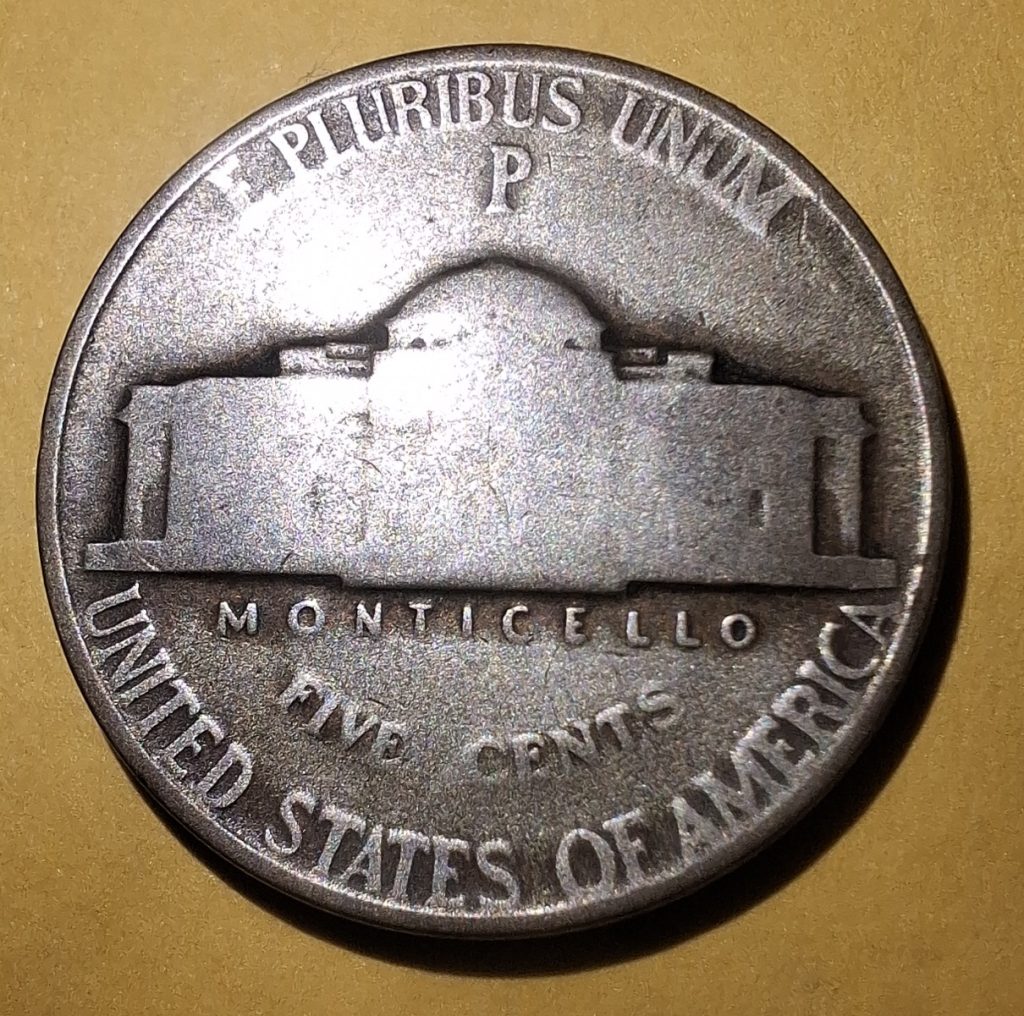
- Type 2 (wartime alloy — silver): A large mintmark placed above the dome of Monticello on the reverse (found on San Francisco “S” coins and most Philadelphia “P” coins of this type). Thus, the position and size of the mintmark are the easiest way to identify a War Nickel.
Mintage and Notable Varieties
The year 1942 was a mixed one:
- Philadelphia produced both variants (Type 1 and Type 2).
- Denver struck primarily the normal (Type 1) alloy.
- San Francisco produced the silver (Type 2) version.
This means the year includes easily recognizable varieties with different relative rarities.
Numismatic Value — Factors That Affect Price
The value of a 1942 War Nickel depends on several factors:
- Variety (Type 1 vs. Type 2): The silver (Type 2) coins are generally more desirable due to their wartime composition.
- Condition / Grade: As with all coins, higher-grade examples (AU/MS) are worth significantly more than circulated ones.
- Mintmark and rarity: Certain mint/date combinations and minting errors are more collectible.
- Errors and varieties (e.g., repunched mintmarks, overdates, laminations): documented errors can add extra value.
Price Ranges (Approximate)
- Common circulated examples (Type 1 or Type 2, lower grades): usually worth only a few dollars, often above face value due to collector interest.
- Well-preserved / lightly circulated examples (AU / MS60+): typically worth several tens of dollars.
- Certified high-grade pieces (MS65+), rare varieties, or major errors: can reach hundreds or even thousands of dollars at auction depending on rarity and demand.
Note: exact values fluctuate with the market and auction results; consult updated price guides (PCGS, NGC, CoinStudy, GainesvilleCoins, etc.) and recent auction data for current pricing.
Practical Tips for Collectors
- Identify the variety first: check for the large mintmark above Monticello’s dome to confirm the silver wartime alloy.
- Check the condition before buying or selling; consider certification by a reputable grading service (PCGS or NGC) for higher-value pieces.
- Be cautious about authenticity: some coins may show surface alterations. If in doubt, seek expert evaluation.
Conclusion
The 1942 5-cent coin (when of the wartime 35% silver alloy) is a fascinating example of how historical events — especially the war — influenced coin production. It is both a historical artifact and an accessible collectible: many examples are inexpensive and great for beginners, while well-preserved or rare varieties can be worth considerably more. To determine the fair value of a specific coin, consult up-to-date guides and recent auction results.