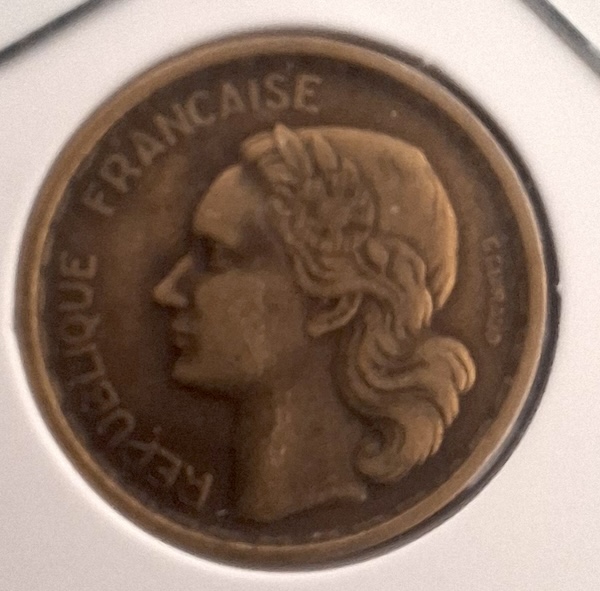
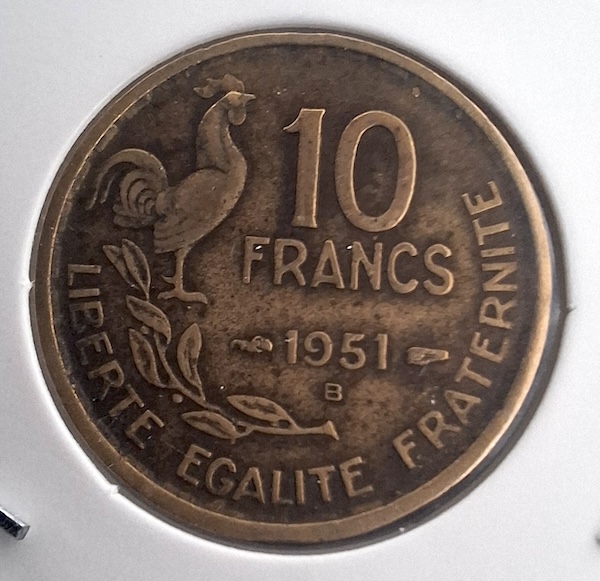
The 10 Francs 1951 with the “B” mint mark is a French coin issued during the Fourth Republic period (1946–1958). It is a circulation coin, but it holds historical and collectible interest due to its post-war economic context and its different minting variants.
Historical context
In 1951, France was in a phase of economic reconstruction following the Second World War. The monetary system still used the old franc, before the introduction of the new franc in 1960. Coins from this period reflect a recovering economy and strong industrial production.
The 10 Francs series of this era features the inscription “République Française” and the national motto “Liberté, Égalité, Fraternité,” reinforcing France’s republican identity in the post-war years.
Coin specifications
The 10 Francs 1951 B coin has the following main characteristics:
- Country: France
- Face value: 10 Francs
- Year: 1951
- Mint mark: B (Beaumont-le-Roger)
- Composition: aluminium-bronze
- Weight: approximately 3.0 g
- Diameter: 20 mm
- Shape: round
- Mintage: over 100 million pieces
The “B” mint mark identifies the Beaumont-le-Roger mint, one of the facilities that produced this issue alongside the Paris mint.
Design and symbolism
The obverse typically features an allegorical representation of the French Republic, often depicted as a female figure symbolizing liberty and the nation.
The reverse shows the denomination “10 Francs” along with the year of issue, usually accompanied by decorative elements such as laurel branches and the Gallic rooster, a national symbol of France.
Numismatic value
From a collector’s perspective, this coin is considered very common, due to its high mintage and wide circulation.
Its value depends heavily on condition:
- Circulated (heavily worn): about €0.20 to €0.40
- Good condition (VF/XF): about €0.50 to €2
- Uncirculated (UNC): up to around €2 to €3, sometimes slightly more in special cases
Despite minor variations between catalogs and markets, the general consensus is that it is not a rare coin, but rather an accessible and common piece in European numismatics.
Factors influencing value
Even though it is common, certain factors can slightly increase collector interest:
- High preservation quality (minimal wear)
- Original mint luster
- No artificial cleaning (cleaned coins lose value)
- Rare minting errors
- Demand in themed French post-war coin collections
Numismatic interest
Although its monetary value is low, this coin is historically significant because it represents:
- France’s pre-euro monetary system
- Post-war economic recovery
- Industrial-scale coin production
- Different minting facilities (Paris and Beaumont-le-Roger)
Conclusion
The 10 Francs 1951 B coin is a typical French circulation coin of the 20th century, with a very high mintage and low market value. However, it remains of historical and collectible interest as part of the evolution of French currency.