Historical Background
In 1974, Algeria issued the 5 dinar coin to commemorate the 20th anniversary of the Revolution (1954–1974)—a recurring theme in post-independence Algerian numismatic design. This issue belongs to the commemorative series marking that occasion.
Description and Technical Specifications
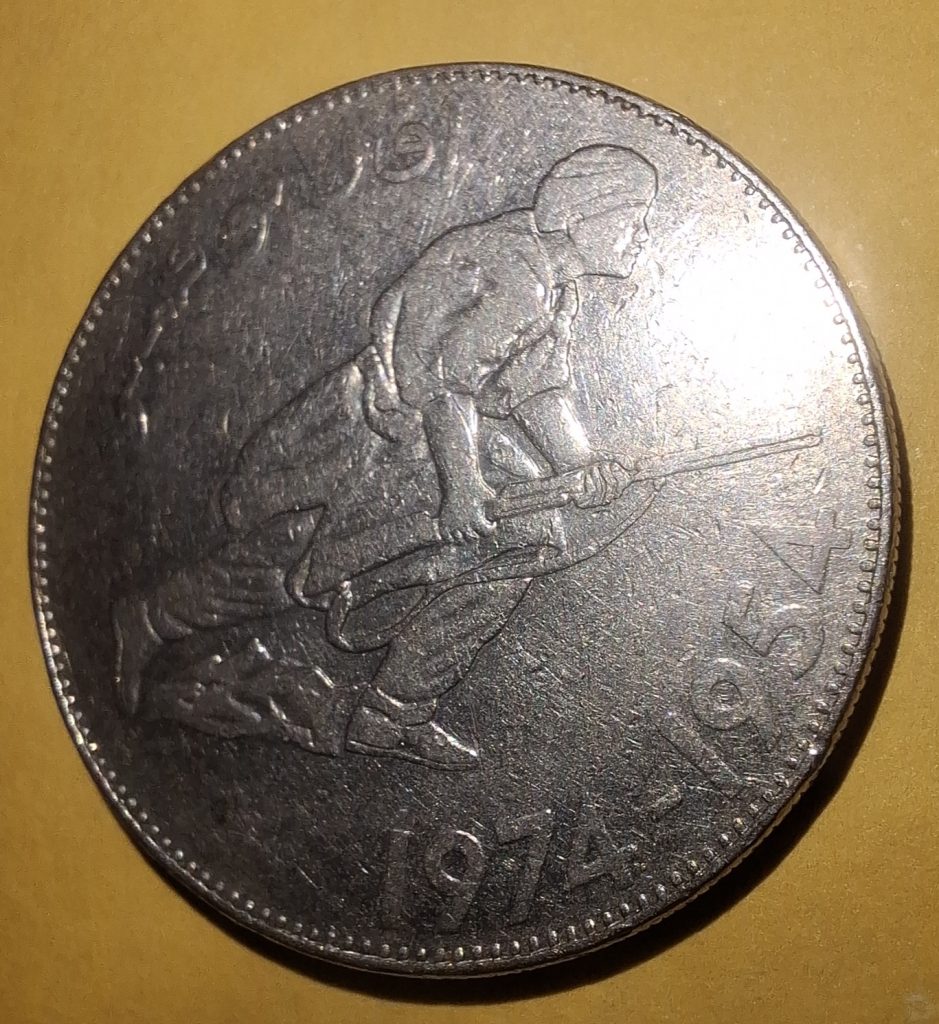
- Year: 1974 (with the dates 1974–1954 depicted alongside the figure).
- Metal: Nickel / cupronickel.
- Weight: approx. 12.00 g.
- Diameter: approx. 31 mm.
- Edge: Reeded.
- Obverse: Depicts a revolutionary soldier advancing, with Arabic inscriptions and the dates “1974–1954”.
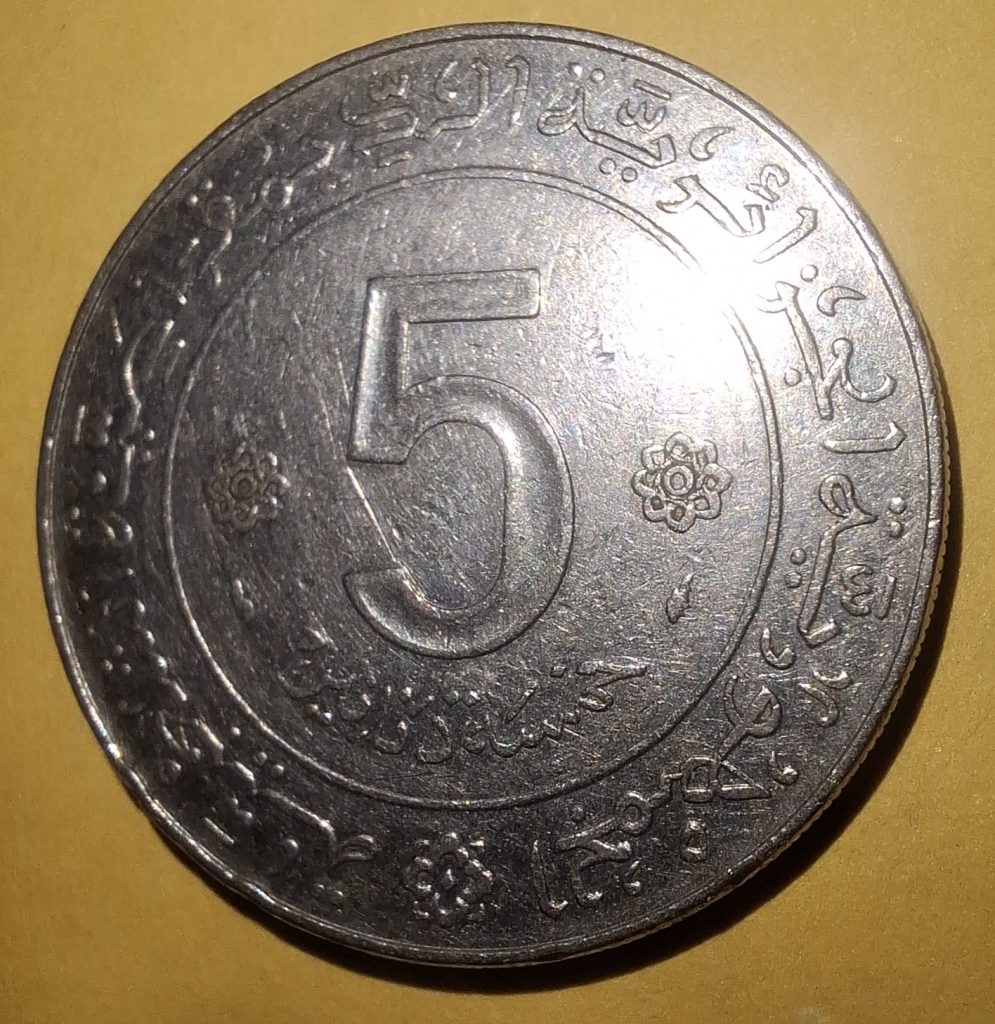
- Reverse: Large number “5” at the center, surrounded by an Arabic inscription naming the issuing authority (Bank/Republic of Algeria) and decorative motifs.
These specifications match well-known catalogues (KM#108 – Krause, Numista, NGC, etc.).
Minting and Variants
The main issue was produced by francophone mints (often associated with the Paris Mint). There are also trial strikes (essai / test / pre-series) and proofs with very small mintages—these are highly sought after by collectors.
Mintage
The regular circulating mintage is not always clearly published, but trial strikes appear in specialized catalogues with very low mintage figures (e.g., around 2,250 for certain essai issues). For precise numbers, specialist catalogues or mint archives are recommended.
Numismatic Value — What Influences Price
Several factors determine market value:
- Condition (F, VF, XF, UNC, Proof/ESSAI) — better condition means higher value.
- Variant (circulation vs. essai / proof / pre-series) — trial strikes are rare and far more expensive.
- Certification (NGC/PCGS) — certified pieces generally achieve better prices at auction.
Price Ranges (approximate, based on recent sales)
- Common circulated examples: usually a few euros/dollars — often €3–€15 depending on wear.
- Uncirculated (UNC) or high grade (XF+): often €10–€50, sometimes up to US$50–100 depending on the venue.
- Trial strikes / pre-series / proofs: may reach hundreds to thousands of euros/dollars, depending on rarity, grade, and provenance.
Note: These values are approximate and depend on current market demand, seller location, auction fees, and exact condition. For an accurate assessment, compare recent sales of similar pieces or consult a numismatic professional.
Tips for Buyers and Sellers
- Condition matters: clear photos of both sides and honest grading help significantly.
- Certification is recommended for high-value pieces: especially essai and proof variants.
- Compare auctions and specialist dealers: studying past sales (eBay, major auction houses, Numista, NGC) helps establish fair value.
- Watch for variants: some advertised “varieties” are simply differences in wear or may be counterfeit—seek expert advice for unusual pieces.
Conclusion
The 1974 Algerian 5 dinar is historically important, visually appealing, and quite accessible in circulated condition. However, trial strikes and proof variants can be significantly more valuable.
If you have a specific coin, I can help estimate its value—just send a photo and I will analyze its condition and characteristics.