Historical Introduction
The 1964 5-cent coin (also catalogued as 6 pence) is part of the circulating series issued for Rhodesia — the territory that, in 1965, made the historic Unilateral Declaration of Independence (UDI). In 1964, the coins still carried the portrait of Queen Elizabeth II on the obverse, typical of British-Commonwealth issues for African territories of that period.
Technical Specifications
- Year: 1964
- Denomination: 6 pence = 5 cents (KM#1)
- Composition: copper-nickel
- Weight: ~2.8 g
- Diameter: ~19–19.5 mm
- Edge: reeded
- Mintage (1964): approx. 13,500,000 pieces for circulation; proofs also exist in very small quantities
Design and Designers
- Obverse: Right-facing portrait of Elizabeth II, inscription “ELIZABETH THE SECOND.” The portrait was designed by Arnold Machin, widely used in British issues of the time.
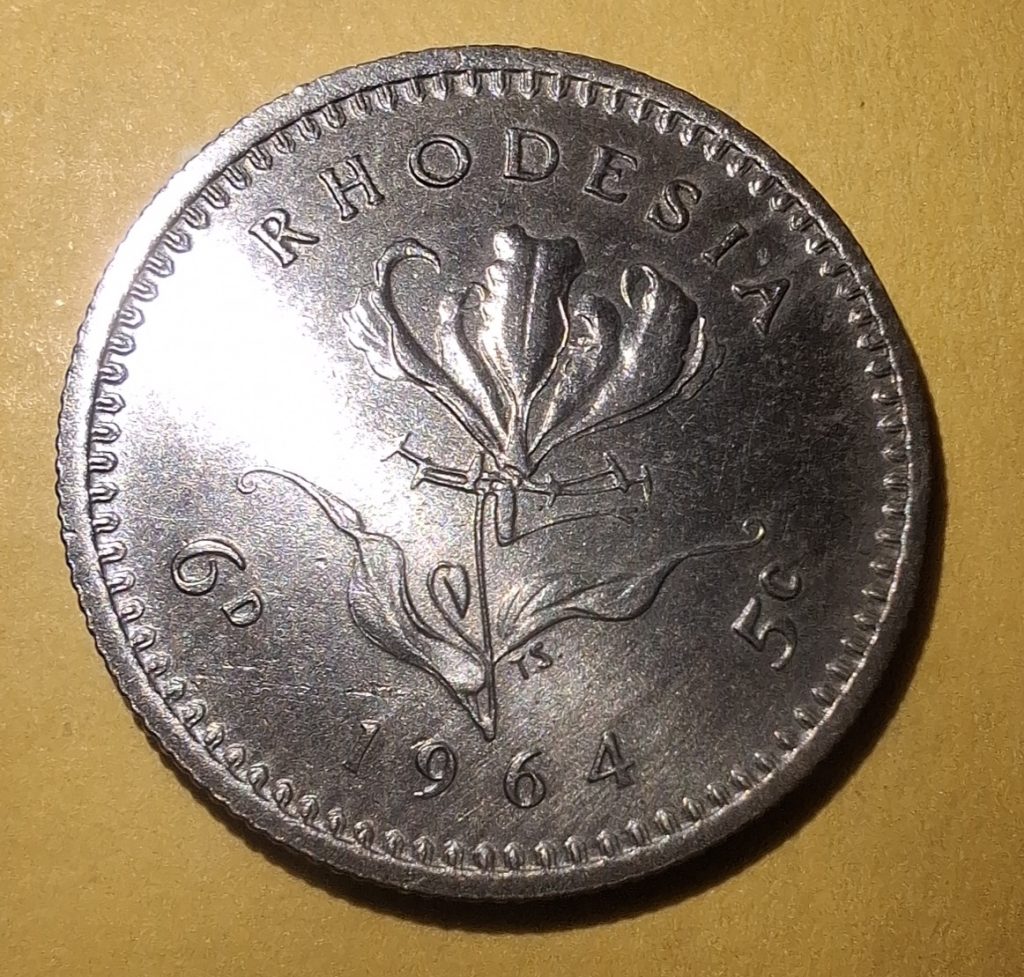
- Reverse: Depicts the flame lily, the national flower of the region, with the legend “RHODESIA” at the top and the date below. The reverse was designed by Tommy (T.S.) Sasseen.
Minting / Mint Location
These coins were struck at the South African Mint (Pretoria) for circulation in Rhodesia. The style and alignment followed the British minting standards of the era.
Numismatic Value
- Rarity: The 1964 issue is common in circulated grades due to its high mintage. It is not considered rare in lower conditions, but proof specimens and high-grade pieces (MS/UNC) can command significantly higher prices.
- Price range (general guidance): Circulated examples typically sell for a few dollars or less. High-grade pieces (EF/XF/UNC) and proofs can achieve higher values, sometimes reaching the tens of dollars, depending on demand, lustre, strike, and market conditions.
Actual prices vary, so checking recent sales (eBay, specialist auctions, dealers) is recommended for accurate market comparisons.
How to Evaluate a Specimen
- Condition (grade): The most important factor. Wear on the lily flower or the Queen’s portrait significantly affects value.
- Toning: Attractive toning can increase desirability; harsh cleaning generally reduces value.
- Proofs and variants: Proof coins have a much lower mintage and are more valuable.
- Authenticity: Although the coin is common, always verify weight, measurements, and compare details—especially when buying “UNC” examples at higher prices.
Conclusion — Why Collect This Coin?
The 1964 5-cent/6-pence coin represents an important historical moment: the political transition in Southern Africa and the final appearance of the royal portrait before Rhodesia’s UDI. It is an accessible and visually appealing coin (featuring the flame lily), popular among collectors of British Commonwealth, African issues, and floral motifs. High-grade and proof pieces offer additional interest for more advanced numismatists.