1. Historical Context
- The 1989 50 centavos coin belongs to the Cruzado Novo (NCz$) monetary standard, which was in place during a transitional period in Brazil in the 1980s.
- The Cruzado Novo was introduced to try to curb the hyperinflation affecting the country. The monetary reform was formalized by provisional measure and law in 1989.
- A large number of coins were minted: for the 1989 50 centavos, 453.8 million units were issued.
- In 1990, more coins of this type were minted (216.6 million), but shortly after the Cruzado Novo was replaced by the Cruzeiro.
2. Physical Characteristics and Design
Material and Dimensions
- The coin is made of stainless steel, making it durable and lightweight.
- Weight: approximately 2.83 g.
- Diameter: 19.5 mm.
- Thickness: about 1.2 mm.
- Edge: smooth (no reeding).
- Alignment: coin alignment.
Design (Obverse and Reverse)
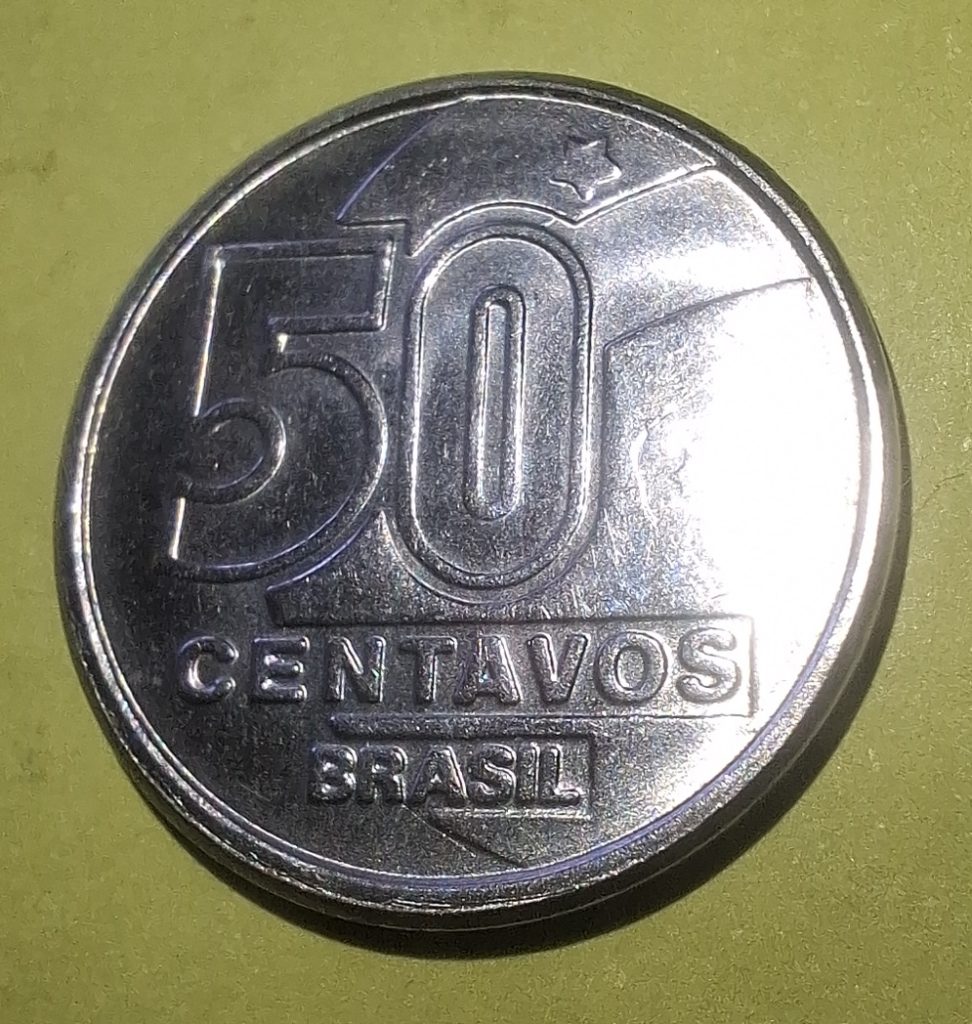
- Obverse: features the large numeral “50,” the word “CENTAVOS,” and “BRASIL.” The background echoes the center of the Brazilian flag, and on the right, there are five stars representing the value in Braille, an interesting accessibility feature.
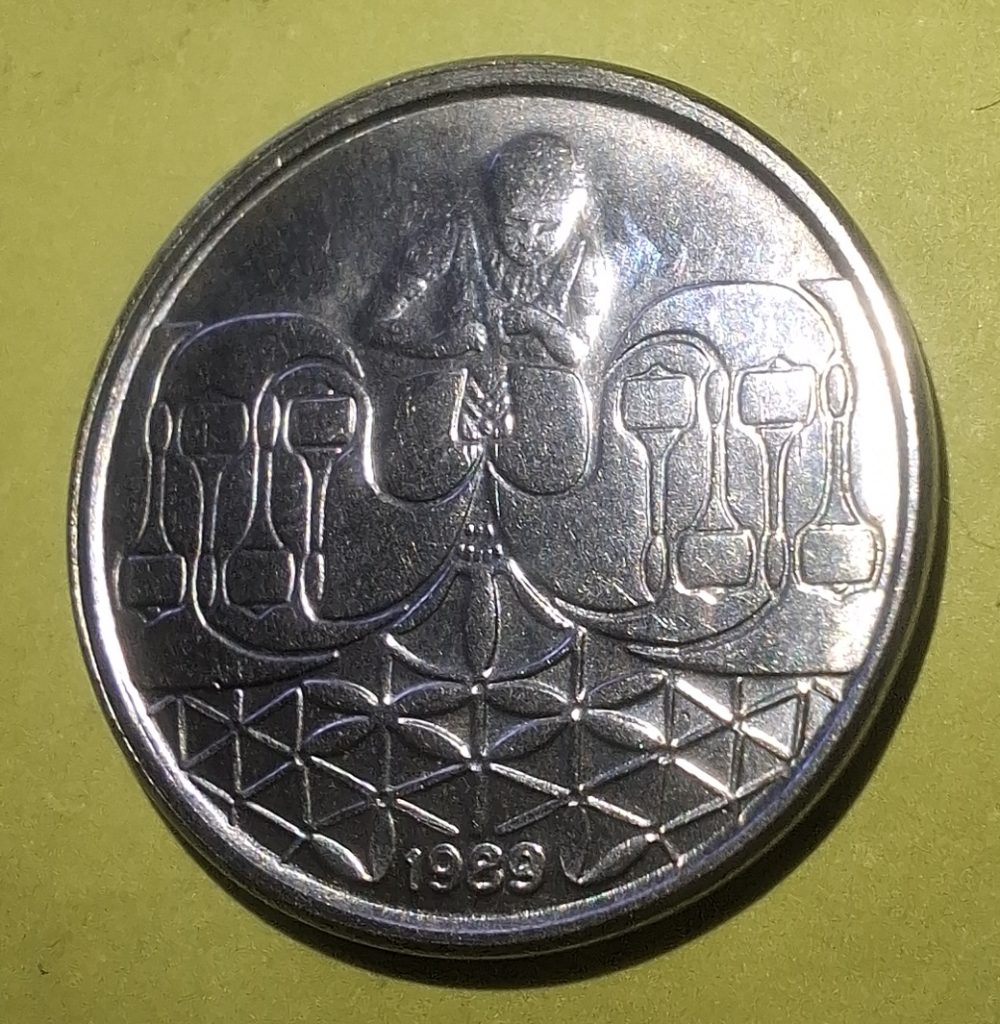
- Reverse: depicts a kneeling woman weaving — a lace maker — over a stylized weaving pattern, honoring the Northeastern Brazilian craft tradition.
- The mint year appears below the lace maker figure.
Identification
- In numismatic catalogs, this coin is referenced as “Brazil 50 Centavos (Rendeira) 1989‑1990.”
- Krause‑Mishler (KM) catalog number: KM 614.
3. Circulation and Demonetization
- The coin was demonetized (ceased to be legal tender) when the monetary standard changed on March 16, 1990, replaced by Cruzeiro coins.
- Despite demonetization, many coins remained in circulation for a while until withdrawn.
4. Numismatic Value
Mintage and Rarity
- As mentioned, the coin had a large mintage (453.8 million for 1989), making it relatively common.
- On Numista, many users report owning the 1989 coin, confirming that it is not extremely rare.
Market Values / Pricing
- Numista estimates the 1989 coin’s value (for collectors) depending on condition:
- UNC (Uncirculated): about US$ 0.79.
- In circulated conditions (Very Fine, Good), the value is significantly lower.
- European catalogs list prices between €0.40 and €0.71, depending on condition.
- Brazilian numismatic sellers list coins in “Very Fine” condition for about R$1.00.
- Prices vary based on conservation, rarity, and marketplace.
Factors Influencing Value
- Condition: Coins without scratches or wear, with original luster (“Flor de Cunho,” Uncirculated) are more valuable.
- Mintage: Although the mintage is high, different years or variants may have different values.
- Collector demand: High demand can increase value.
- Local vs international market: Prices vary by country and sales channel (auctions, dealers, marketplaces).
- Errors or varieties: Coins with minting errors may be worth more, although no common errors are reported for this coin.
5. Numismatic and Cultural Importance
- The lace maker image highlights Brazilian Northeastern popular culture; bobbin lace is an important regional craft.
- The inclusion of Braille code in the design (stars representing the value) is a unique and inclusive detail, uncommon for circulating coins.
- As a transitional coin (Cruzado Novo), it represents a turbulent economic period in Brazil (hyperinflation, monetary reforms), making it historically significant for collectors.
Conclusion
- The 1989 50 centavos coin (“Rendeira”) is relatively common but remains interesting to collectors for its design, symbolic, and historical value.
- Its numismatic value is modest (usually under €1 or a few reais in average condition) but can rise for coins in excellent condition or rare variants.
- For beginner collectors, this coin can serve as a good “entry piece” into Brazilian numismatics of the late 1980s due to its accessibility and historical representation.