Historical Context
The Escudo coin was Portugal’s official currency from 1911 to 2001, when it was replaced by the euro.
During the First Portuguese Republic (1910–1926), several escudo coins were issued — among them, the 1 Escudo coin of 1924.
In 1924, Portugal was still undergoing political and economic instability, a period marked by efforts to stabilize monetary values and modernize coin production. This coin emerged within that transitional and reformative context.
Technical Characteristics
- Year of issue: 1924
- Face value: 1 Escudo
- Material: Bronze-aluminum alloy (approx. 95% copper + 5% aluminum)
- Weight: ~ 8 g
- Diameter: ~ 26.8 mm
- Edge: Reeded (milled)
- Minting and mint: Produced by the Imprensa Nacional – Casa da Moeda, Lisbon
- Mintage: Some references cite 2,709,000 coins for 1924; others mention 7,716,000 — this discrepancy may result from variant listings or catalog inconsistencies.
Design and Symbolism
- Obverse: Depicts a seated female allegory representing the Republic, holding a symbolic object, surrounded by the legend “REPÚBLICA PORTUGUESA” and the date “1924”.
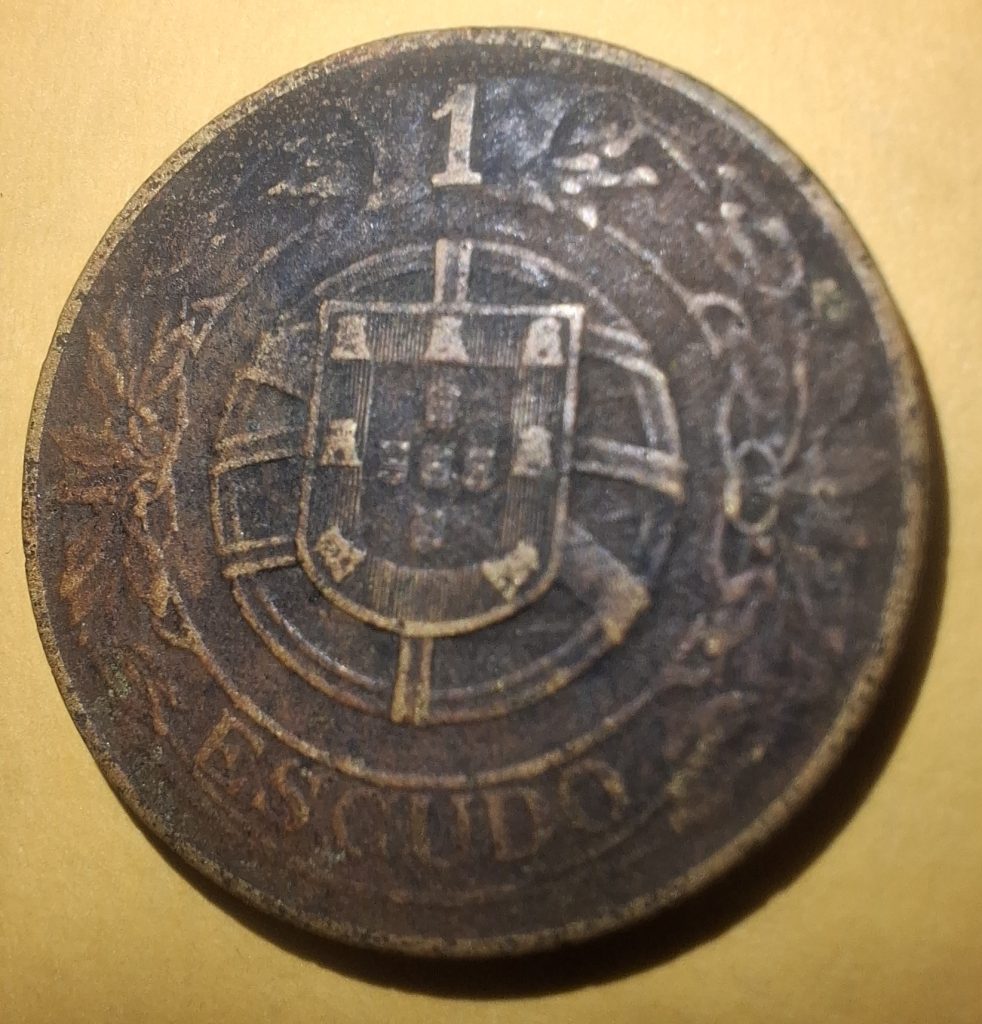
- Reverse: Displays the denomination “1 ESCUDO”, encircled by decorative elements and featuring the Portuguese coat of arms in a central medallion or near the design field (depending on the variety).
This style was characteristic of Republican iconography, symbolizing the nation, liberty, and modernization.
Circulation and Demonetization
The coin circulated in Portugal during and after the First Republic until later monetary reforms rendered it no longer legal tender.
With the adoption of the euro in 2002, it became a collectible item with numismatic value only.
Numismatic Value
The commercial value of this coin depends on several factors: state of preservation, mintage figures, collector demand, rarity, possible varieties, and authenticity.
Reference data:
- Average value of around €20 for coins in XF (Extremely Fine) condition.
- Some listings show examples offered for around €15, with unspecified or moderate condition.
These figures indicate that — while it is historically significant and collectible — the 1924 1 Escudo is not a particularly rare or high-value coin, especially in worn or average condition.
However, exceptionally well-preserved pieces (uncirculated, with original patina and no damage) can fetch higher prices, though public auction records for this exact date and denomination remain modest.
Factors that Increase or Decrease Value
Increase Value:
- Superior preservation (sharp details, minimal wear)
- Original finish and intact patina
- No cleaning or repair
- Uncommon variety or minting error (if identified)
- High demand among collectors of Republican-era Portuguese coins
Decrease Value:
- Heavy wear, scratches, or damage
- Harsh cleaning that removes original patina
- Common examples with no rarity factor
- Counterfeits or pieces of uncertain origin
Recommendations for Owners or Buyers
- Assess the grade using standard numismatic scales (VG, F, VF, XF, AU, UNC).
- Consult catalog references for approximate market values.
- Request detailed photos (obverse, reverse, edges, patina) and ensure clear provenance before buying.
- Avoid polishing or aggressive cleaning — original patina adds value.
- Store the coin in a dry, dark, humidity-controlled environment.
- For selling, consider numismatic dealers or specialized auction platforms, and compare realized sale prices, not just asking prices.
Conclusion
The 1924 1 Escudo coin represents an important fragment of Portuguese monetary history, reflecting the First Republic era and the evolution of Portugal’s currency system.
Technically, it is a well-crafted bronze-aluminum piece with a classical allegorical design and a relatively high mintage, making it not rare, but still a desirable collectible.
For collectors and enthusiasts, it can be a worthwhile addition, especially in high-grade condition.
However, one should not expect high market values (thousands of euros) unless the coin is in exceptional condition or displays an unusual variant.