1. Historical Context
- The 300 réis coin was part of Brazil’s old monetary system (Réis), which was in use until 1942.
- This specific version (1940) was minted during the government of Getúlio Dornelles Vargas in his first term (1930–1945).
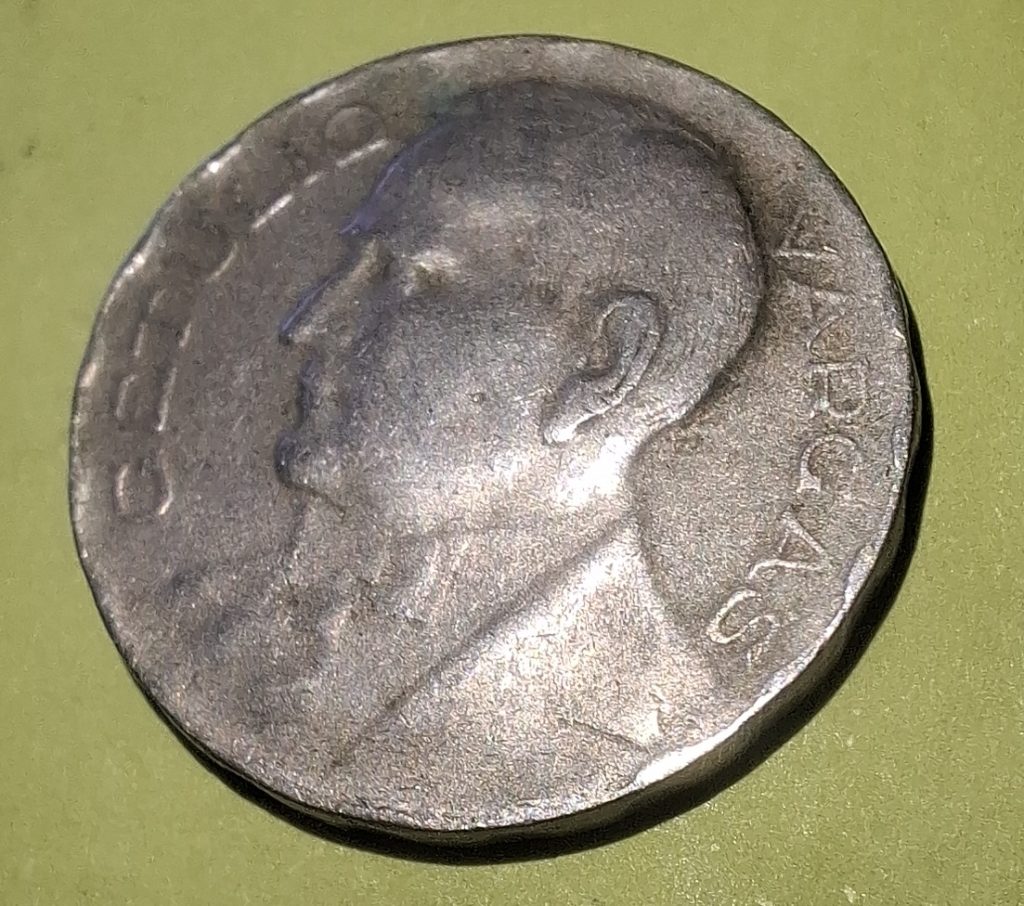
- Vargas’s portrait appears on the obverse of the coin, reinforcing the political symbolism of the period.
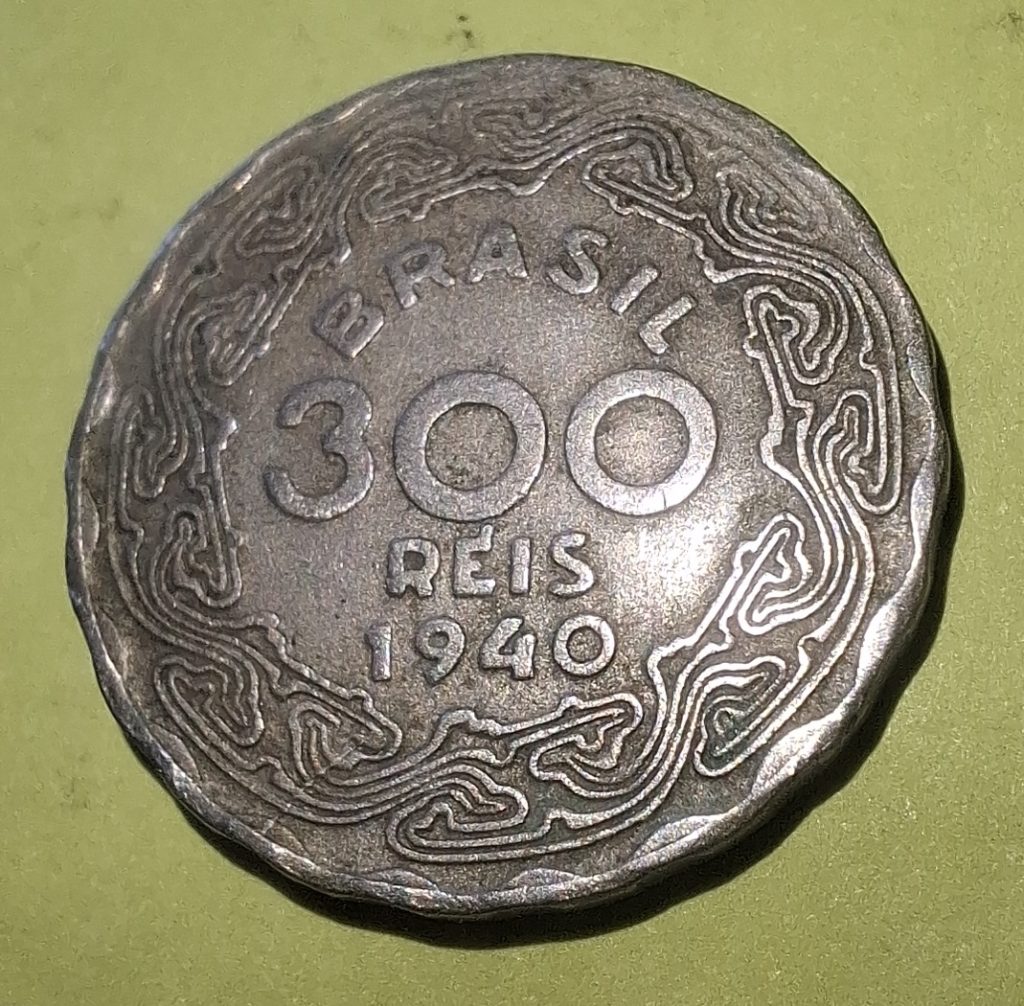
- The reverse shows the denomination “300 RÉIS” above the date, surrounded by a decorative pattern inspired by Marajoara art, typical of the indigenous culture of Marajó Island.
- The coin was produced by the Casa da Moeda do Brasil (Brazilian Mint) in Rio de Janeiro.
2. Technical Specifications
| Attribute | Value |
|---|---|
| Denomination | 300 Réis |
| Year | 1940 |
| Mintage | Approximately 8,124,000 units |
| Metal / Composition | Cupronickel (copper-nickel alloy) |
| Weight | ~ 4.4 g |
| Diameter | ~ 21.0 mm |
| Thickness | ~ 1.7 mm |
| Edge | Reeded or scalloped |
| Orientation | Coin alignment (“↑↓”) |
| Catalog Reference | Standard Catalog of World Coins: KM# 546 |
3. Design (Obverse and Reverse)
- Obverse: Features a left-facing bust of Getúlio Vargas, with the inscription “GETULIO VARGAS” around the edge.
- Reverse: Displays the value “300 RÉIS” over the date 1940, with “BRASIL” above it, all surrounded by a decorative Marajoara-inspired border.
- The Marajoara motifs emphasized national identity during a period when political symbolism was widely promoted.
4. Circulation and Durability
- Made of cupronickel, the coin was durable and resistant to wear, suitable for everyday circulation.
- With a mintage of roughly 8.1 million, it was not a rare coin at the time but intended for regular use.
- Following Brazil’s monetary reform in 1942, the Réis was replaced, and these coins were eventually demonetized.
5. Numismatic Importance
- The 300 réis coin of 1940 is valued by collectors for representing the final years of the Réis system and the Vargas era, a period of centralization and economic change.
- Part of a fractional coin series (including other denominations) minted between 1938 and 1942.
- Its age and metal composition make it collectible, particularly for those specializing in presidential or Réis-era coins.
6. Numismatic Value (Market Prices)
The coin’s value depends largely on its condition:
- According to Numista:
- Very Good (VG): ~$0.39
- Fine (F): ~$0.87
- Extremely Fine (XF): ~$1.00
- Almost Uncirculated (AU): ~$1.30
- Uncirculated (UNC): ~$2.40
- In Brazilian numismatic markets:
- A coin in “Brilliant / Flor de Cunho” condition: ~R$ 55.00
- Another in “Brilliant” condition: ~R$ 30.00
- Internationally, a 300 réis 1940 coin (KM 546) is listed for around € 5.00.
While not extremely rare or high-value, it remains appealing to collectors completing Réis-era series.
7. Factors Affecting Value
- Condition: Better-preserved coins command higher prices.
- Mintage: With 8.12 million coins, it was not extremely limited.
- Collector Demand: Those focused on the Vargas era or Réis coins may value it more.
- Metal: Cupronickel coins have low intrinsic metal value, so the worth is mainly collectible.
- Market Differences: Prices vary between local Brazilian and international markets depending on availability.
8. Conclusion
The 300 Réis 1940 coin represents a key piece of Brazilian history — politically, during the Vargas era, and monetarily, marking the end of the Réis. Technically, it is a well-made cupronickel coin, combining presidential imagery with indigenous-inspired art.
For collectors, it is accessible across most conditions and serves as a good entry coin for those starting a collection of Réis coins or Vargas-era coins. Despite not being high-value in monetary terms, it carries significant historical and numismatic interest.