1. Introduction and Historical Context
The Eisenhower Dollar series was issued in the United States from 1971 to 1978, being the last large-diameter dollar coin (approximately 38.1 mm) released for circulation before the transition to smaller series.
The coin’s design pays tribute to two important moments:
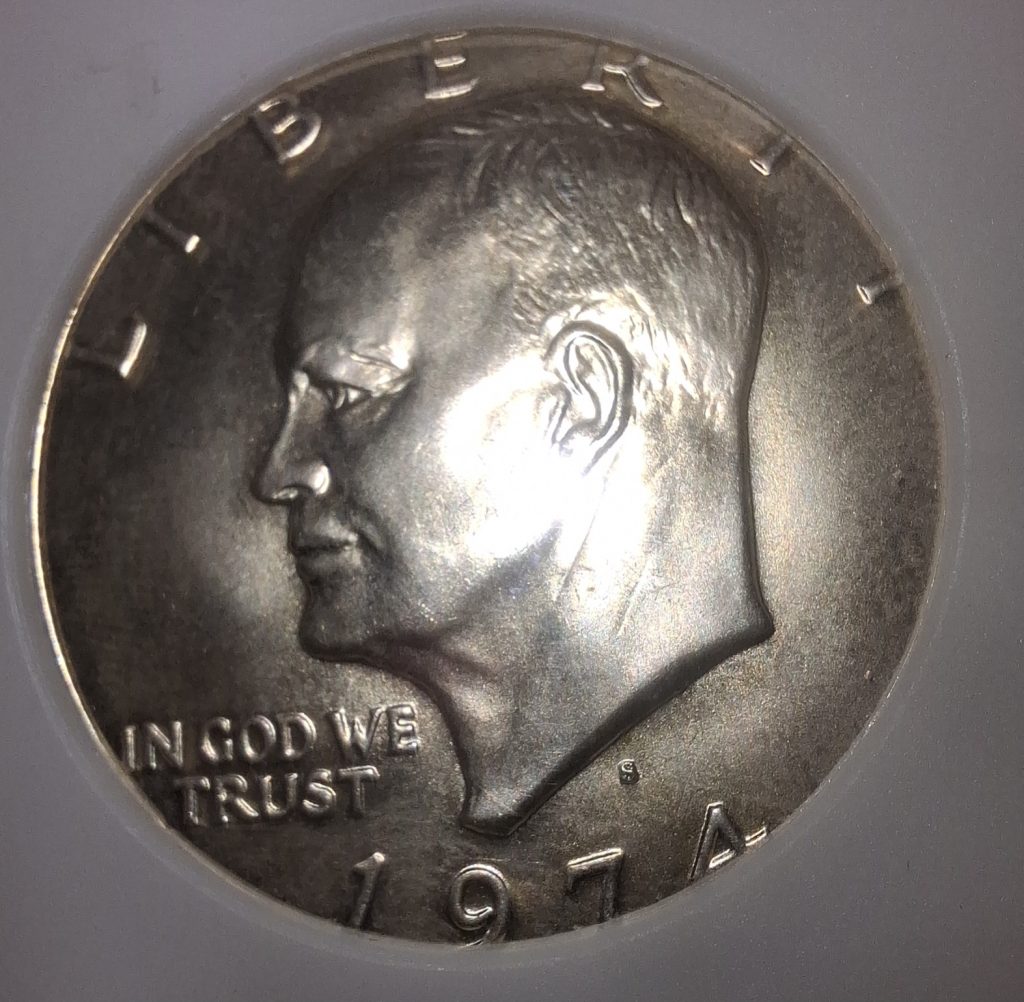
- On the obverse, the bust of the 34th U.S. President, Dwight D. Eisenhower, engraved by Frank Gasparro.
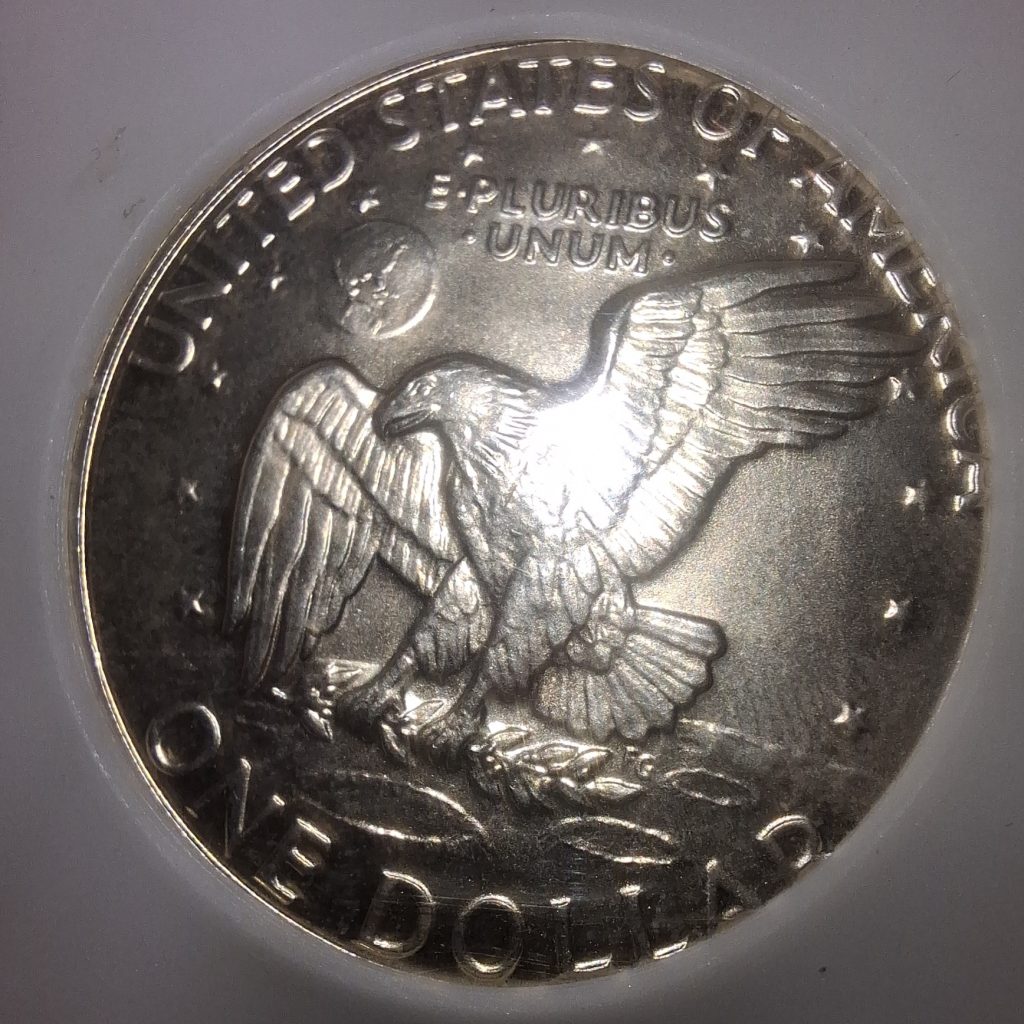
- On the reverse, an eagle landing on the Moon holding an olive branch — inspired by the Apollo 11 mission emblem.
2. Technical Specifications of the 1974 Edition
- Year of issue: 1974
- Diameter: 38.1 mm
- Thickness: ~2.58 mm
- Composition: depends on the mint and variety:
- Regular circulation coins from Philadelphia (no mint mark) and Denver (“D”): copper-nickel clad; contains no silver.
- San Francisco (“S”) mint: collector issues exist in 40% silver-clad, not intended for general circulation.
- Approximate mintages for 1974:
- 1974 (no mint mark): ~27,366,000
- 1974-D (“D” mint mark): ~45,517,000
- 1974-S 40% silver: ~1,900,156 pieces
- 1974-S silver proof: ~1,306,579 pieces
3. How to Identify the “Silver” Variety
It’s very important to note that not all 1974 Eisenhower Dollars contain silver. The 40% silver version was only produced at the San Francisco Mint (“S”) for collectors and was not released into general circulation.
Identification tips:
- Check if the coin has the “S” mint mark below Eisenhower’s bust.
- Examine the edge: the silver-clad version usually shows a uniform silver tone, while the copper-nickel clad coin reveals a visible copper layer between metallic layers.
- Check the weight: the silver-clad version weighs about 24.59 g, according to sellers.
4. Numismatic Value and Factors Affecting Price
Typical Values:
- Common variants (no mint mark or “D”, clad): fairly modest value; around US $1–2 in well-circulated condition.
- “S” silver (40%) variant: significantly higher values — for example, MS65 or higher grades can reach several thousand dollars.
- A 1974-S 40% silver coin graded MS-68+ sold for about US $13,513 in 2021.
- Proof (PR) silver coins of high quality (PR70, Deep Cameo, etc.) are also highly sought after.
Factors Influencing Value:
- Condition (grade): the closer to “uncirculated,” the higher the value.
- Silver vs. clad version: silver greatly increases worth.
- Mint mark (“S” vs. “D” vs. no mark) and type (circulation, collector, or proof).
- Possible minting errors or rare varieties: e.g., misstrikes or low mintage coins can be worth much more.
- Collector demand and market conditions, as with most numismatic items.
5. Considerations for Collectors
- If you own a 1974 Eisenhower Dollar, check carefully for the “S” mint mark, weight, and appearance to determine if it’s the 40% silver variety.
- Even silver coins are not automatically highly valuable — condition matters greatly. A worn or marked silver coin might be worth only slightly above face value.
- High-grade pieces (MS67 or better) can be worth much more — but such examples are rare.
- Store the coin properly: protection against scratches, oxidation, and damage helps preserve its value.
- Consult a numismatic expert or grading company if you believe you have a high-quality or rare piece — certification costs may be worthwhile if the potential value is significant.
- Remember, the market fluctuates: record prices (e.g., US $13,513 for an MS68+ silver piece) are exceptions and don’t guarantee that similar coins will reach those figures.
6. Conclusion
The 1974 Eisenhower Dollar represents an interesting example of numismatic transition in the United States: a large-sized dollar coin with strong collector appeal and versions containing silver (though not all). The “S” 40% silver variety is undoubtedly the most notable in terms of numismatic value — but careful attention to details is essential for identification and evaluation.
For regular circulation (clad) versions, the value remains modest, serving mainly as a historical or entry-level collector’s piece.
If you have a well-preserved specimen, especially the silver variety, it may be worth investigating further.