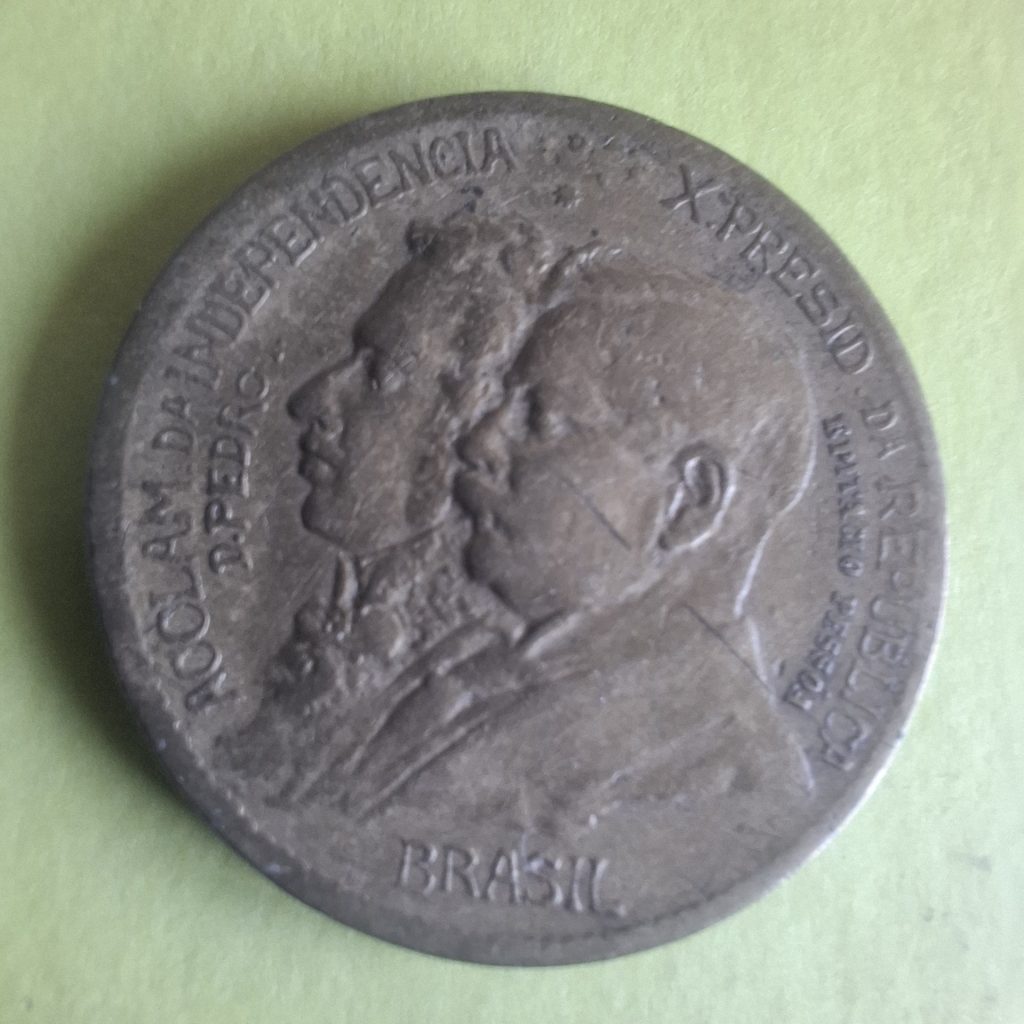
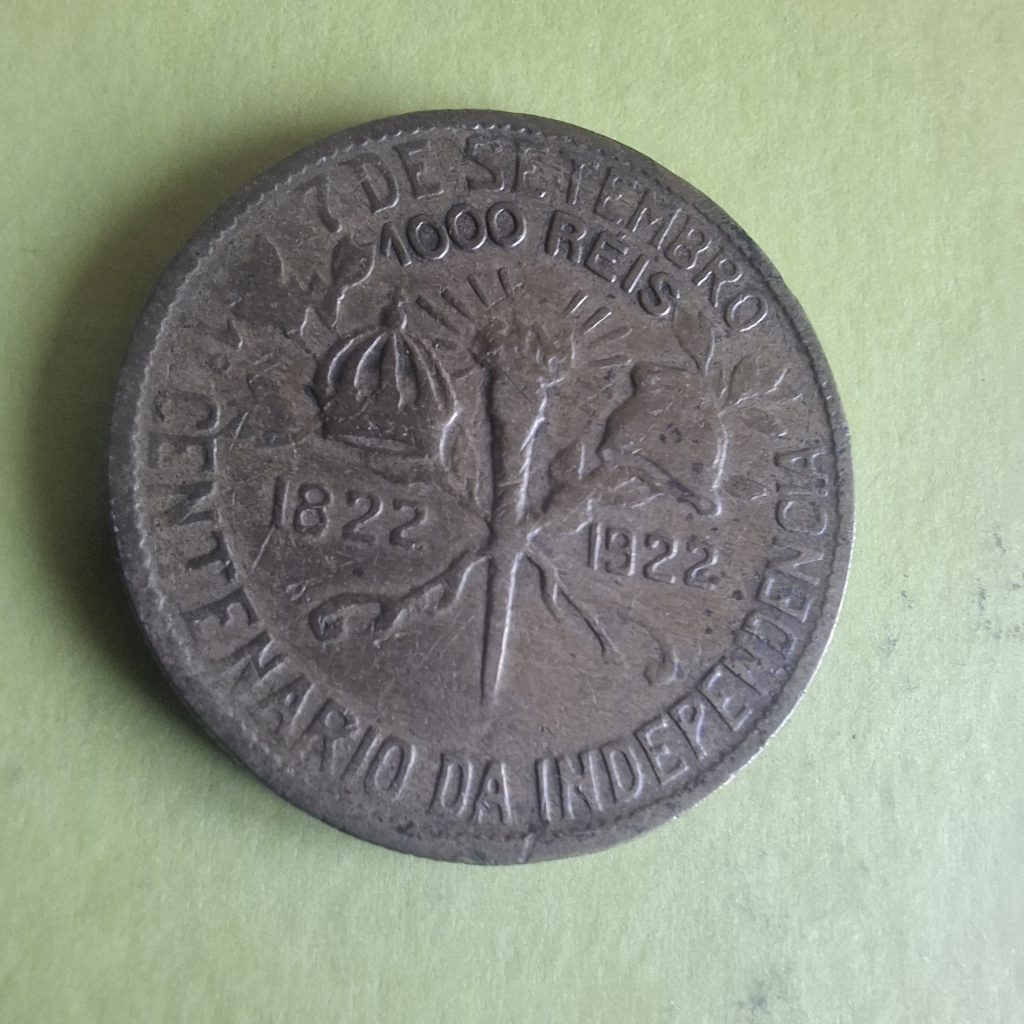
The 1000 Réis coin minted in 1922 to commemorate the 100th anniversary of Brazil’s independence is one of the most iconic items for collectors of Brazilian numismatics. Below is a comprehensive overview of its history, features, and numismatic value.
Features and Description
- Issuer / Period: Brazil, during the Old Republic (1889–1942).
- Face Value: 1,000 Réis.
- Material: Aluminium-bronze.
- Weight: Approximately 8.0 grams (some references note 7.8 g).
- Diameter: ~26.7–26.8 mm.
- Thickness: ~2.2 mm.
- Edge: Reeded.
- Type: Circular coin, milled minting technique.
Design / Iconography
- Obverse: Features side-by-side busts of Dom Pedro I and Epitácio Pessoa — the latter being the president at the time. Around them, the legend:
- Reverse: Shows a torch with two crossed branches — one ending in a crown (symbol of the Empire), the other in a Phrygian cap (symbol of the Republic). Around it are the dates “1822 1922,” the value “1000 RÉIS,” “7 DE SETEMBRO,” and the inscription “1º CENTENARIO DA INDEPENDENCIA.”
This symbolic design celebrates the historical transition from the imperial era represented by Dom Pedro I to the Republican era, blending past and present in a single coin.
Historical Context
The coin was issued to celebrate the centenary of Brazil’s independence in 1822, under Dom Pedro I. Hence the inclusion of his bust and the symbols evoking both the Empire and the Republic.
Even as a commemorative coin, it was part of the standard monetary system (mil-réis) and had a relatively large mintage: about 16,698,000 units.
Despite the high mintage, collectors value this coin — especially in good condition — for its historical importance, symbolic value, and elegant design.
Varieties and Details to Note
- There are versions with the inscription error “BBASIL” instead of “BRASIL,” which is considered rarer and more attractive to collectors.
- Variations exist in the suffix of “D. PEDRO I.” — with and without a period after the “I.”
- References mention a possible “thin-disk version.”
For collectors, identifying these details (minting errors, legend variations, conservation quality) is crucial to determine rarity and actual value.
Current Numismatic Value (Estimates)
The market value varies widely depending on condition, rarity, and variant. Approximate estimates:
| Condition / Grade / Variant | Typical Price* |
|---|---|
| Circulated, fair condition (F, VF) | ~$4 – $6 |
| Moderate to good condition (XF – VF) | $5 – $10 |
| High quality / uncirculated (MS), no wear | $10 – $30+, especially for error variant “BBASIL” |
| Brazilian collector market, good condition | ~R$148 – R$165 for common variants |
- Values fluctuate depending on conservation, variant, collector demand, and market trends. Coins with the “BBASIL” error usually fetch higher prices.
Significance for Collectors and Historical Value
This coin is prized not just for its monetary value but also for its historical and symbolic significance:
- Represents the memory of Brazil’s independence — a key historical milestone.
- Symbolically bridges the monarchy (Dom Pedro I) and the Republic (President Epitácio Pessoa).
- Minting error variants add uniqueness and collector interest.
- As a commemorative coin, it reflects how 1920s Brazil celebrated its history through art and currency.
For collectors of Brazilian coins, it is an essential piece — both in thematic collections (independence, Brazilian history) and general old coin collections.
Conclusion
The 1000 Réis coin of 1922 — Centenary of Brazil’s Independence is more than just old currency. It embodies history, art, and national memory — connecting the legacy of the Empire to the Republic in one piece. For collectors, it offers both a challenge (identifying variants and preservation grade) and a reward: a tangible link to one of Brazil’s most significant historical moments.