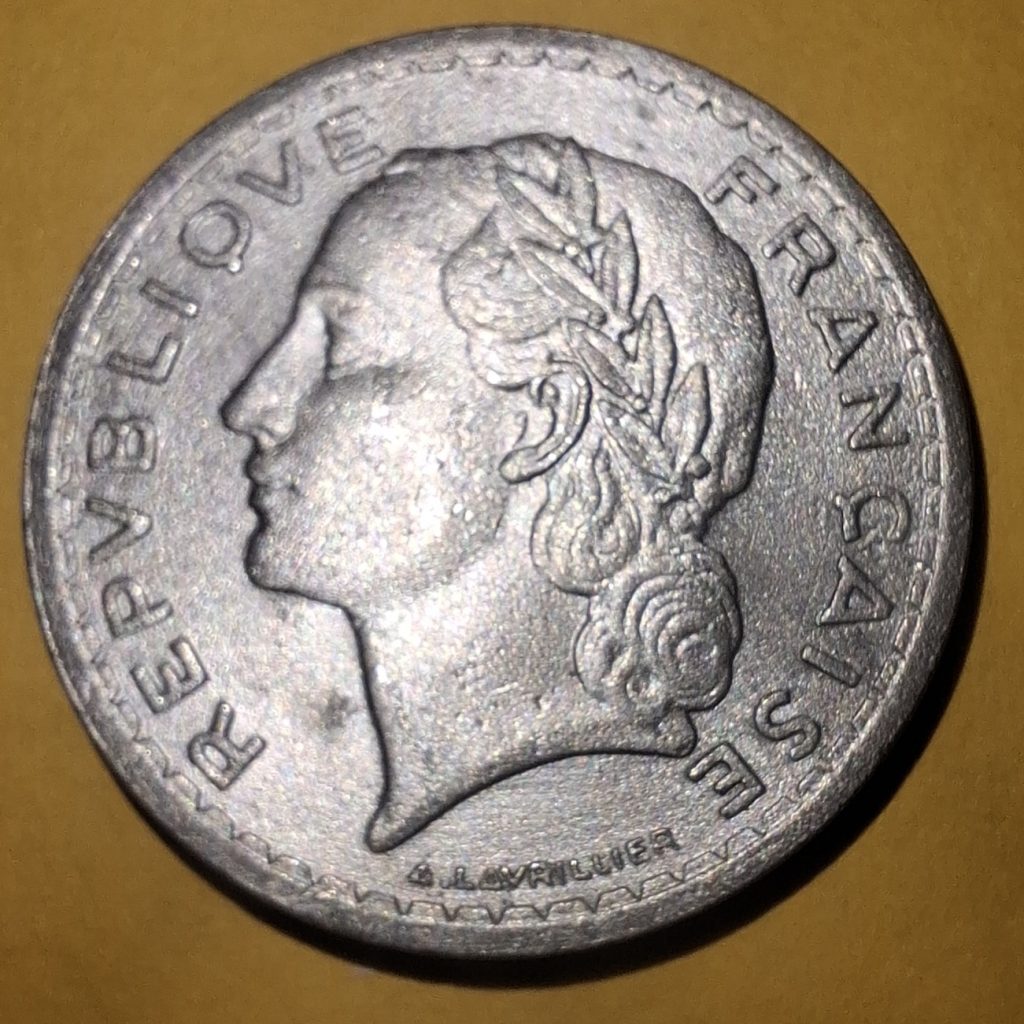
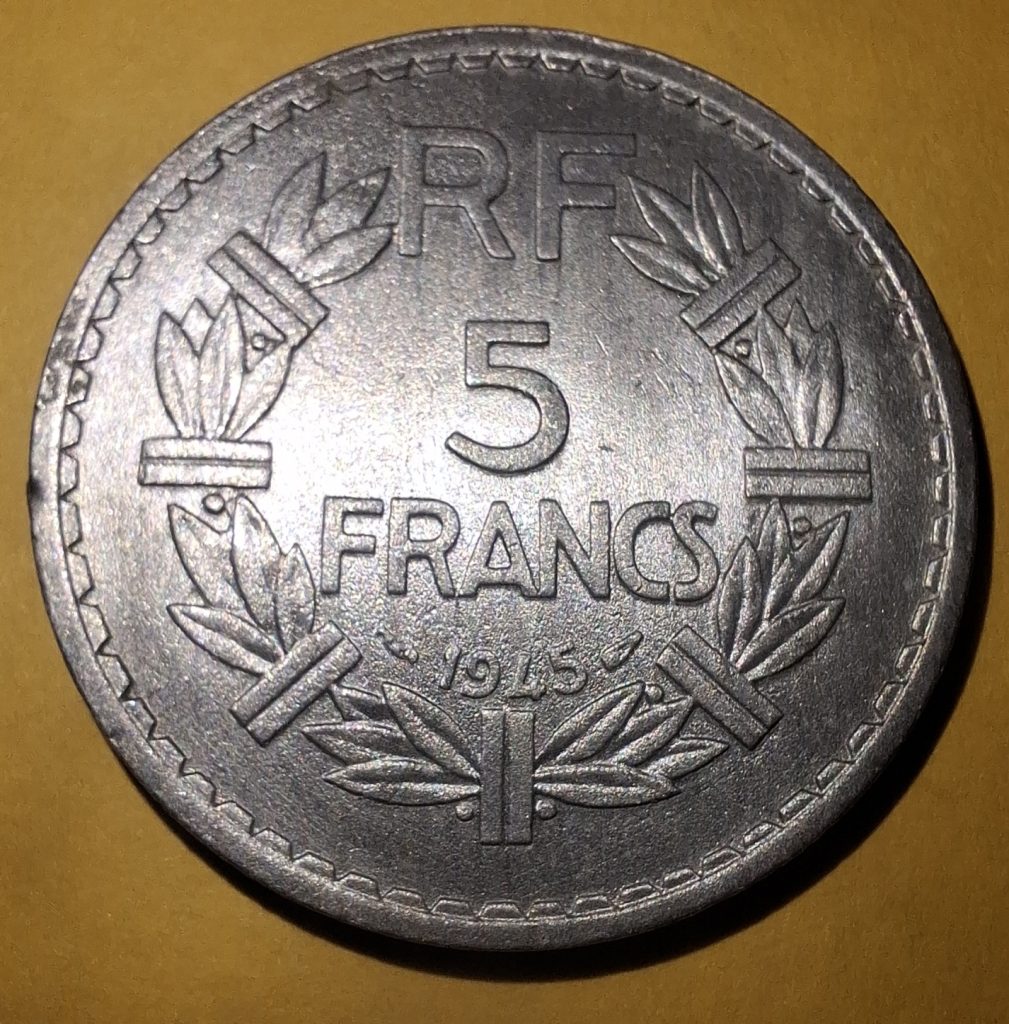
The 5 francs coin of 1945 is a representative piece of the period immediately following World War II, when France resumed coin production under the Provisional Government.
The design, known as the Lavrillier type (signed by sculptor André Lavrillier), temporarily replaced earlier series and was minted in aluminium — a practical choice in a time of metal scarcity.
Description and Technical Specifications
- Year: 1945 (examples dated 1945–1952 exist with the same aluminium type).
- Designer: André Lavrillier (signature appears on the obverse).
- Diameter: ~31 mm.
- Weight: ≈ 3.5–3.75 g (slight variation depending on reference).
- Composition: aluminium (light, silver-coloured coin).
Note: do not confuse with earlier 5 francs issues in aluminium-bronze or other alloys — the 1945 Lavrillier type is aluminium only. - Edge: plain (smooth, without reeding).
- Obverse: laureate bust facing left, legend RÉPUBLIQUE FRANÇAISE around.
- Reverse: denomination “5 FRANCS” centred within a wreath; the letters “RF” (République Française) above; date appears below the wreath.
Varieties and Special Pieces
- Pattern / trial strikes (essais):
In 1945, a limited number of aluminium patterns were struck (e.g. essai F.339/1). These have a very small known mintage and are much rarer and more sought-after by collectors.
Major numismatic catalogues and auction houses record very limited existence of such trial pieces, often fetching prices far above circulation coins. - Differences from earlier types:
The late 1930s 5 francs series (e.g. the “1938” type) had a different composition and weight (aluminium-bronze, 12 g). Care must be taken not to confuse these coins.
Mintage and Circulation
Mintages varied according to mint location and year of issue.
Many circulation pieces exist, but trial strikes and certain mintmark varieties or striking errors are significantly rarer.
Catalogue sources indicate mass circulation issues, but proof or trial series were produced in very limited quantities.
Numismatic Value (Indicative Price Range)
The value of a 1945 5 francs coin depends greatly on its condition (grade), mintmark or striking anomalies, and — most importantly — whether it is a regular circulation coin or a rare pattern/proof piece.
Indicative values based on catalogues and recent sales (prices in euros):
- Common circulation coin (heavily worn / circulated): typically €5–25, often sold by online vendors for modest prices.
- Higher grades (Very Fine to Extremely Fine / Almost Uncirculated): generally €30–200, depending on lustre, absence of marks, and strike quality.
- Proofs / trial strikes (rare):
The 1945 aluminium patterns, with known examples in the hundreds or fewer, can reach several hundred euros.
Auction records show €200–600 or more, depending on grade, rarity, and certification.
Note: these ranges are indicative only. Actual market prices vary by country, platform (auction vs. private sale), and certification status.
How to Assess a Coin (Practical Tips)
- Identify the type:
Confirm it is the Lavrillier aluminium type (laureate bust) and dated 1945. Compare with reference images. - Condition:
Scratches, dents, loss of lustre, or aluminium corrosion significantly lower value. Uncirculated (FDC) pieces are worth much more. - Proofs and patterns:
Look for indicators of a trial piece — the word “ESSAI”, special finish, or catalogue references such as F.339/1. These require expert attention and usually command higher prices. - Authentication / certification:
For high-value pieces (trials or top grades), consider submission to a recognized grading service or numismatic auction house. Certification increases collector confidence and often resale value.
Where to Sell or Get an Appraisal
- Specialized numismatic auction houses and references (e.g. CGB, Numismatica, or catalogues like Le Franc / Franc) provide professional appraisals and record recent sales.
- Collector marketplaces (eBay, VCoins, European platforms) allow quick sales but require caution due to fees and possible fraud.
Conclusion
The 5 francs 1945 Lavrillier type is a historically significant and collectible coin — common in circulation, yet with trial and proof variants that are notably rarer and more valuable.
To estimate its true worth, it is essential to evaluate condition, confirm type and issue, and consult reliable catalogues.
When in doubt — or for coins of higher potential value — professional certification is highly recommended.