Historical Background
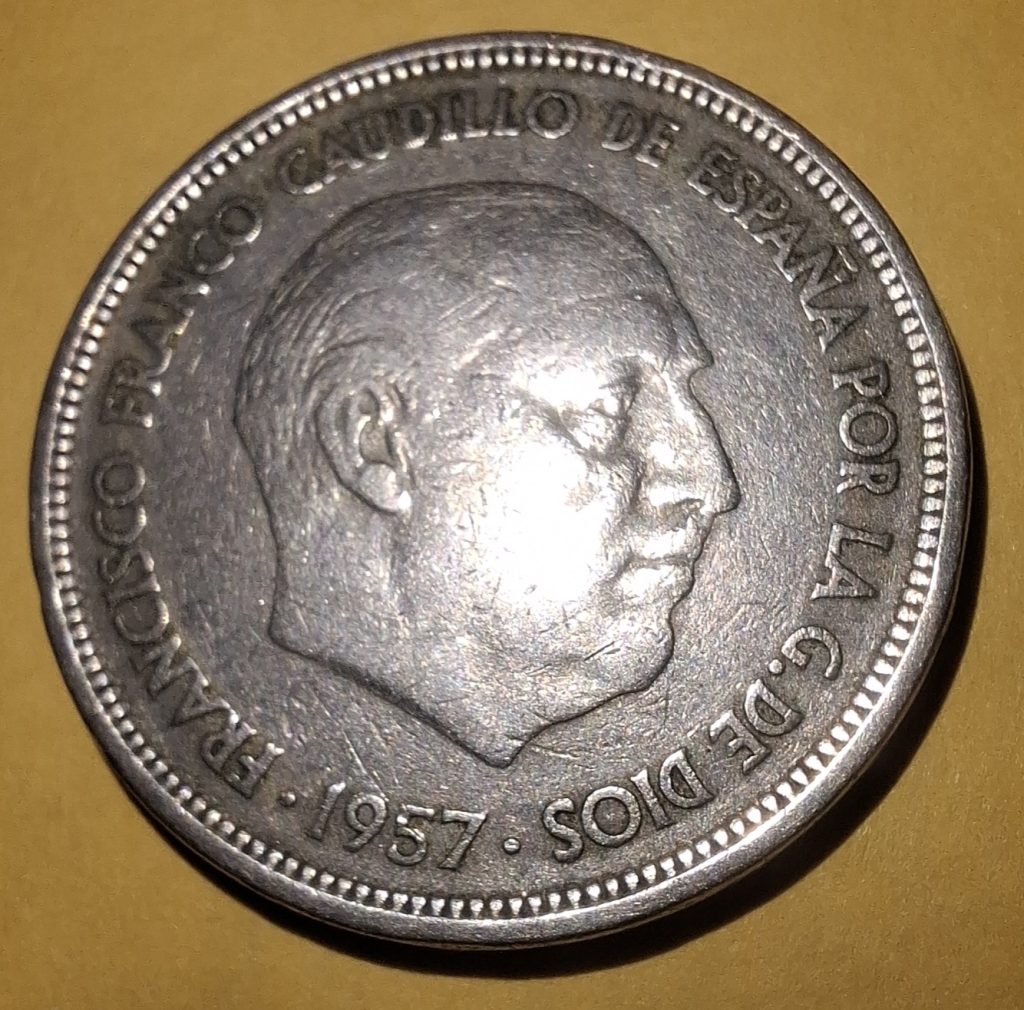
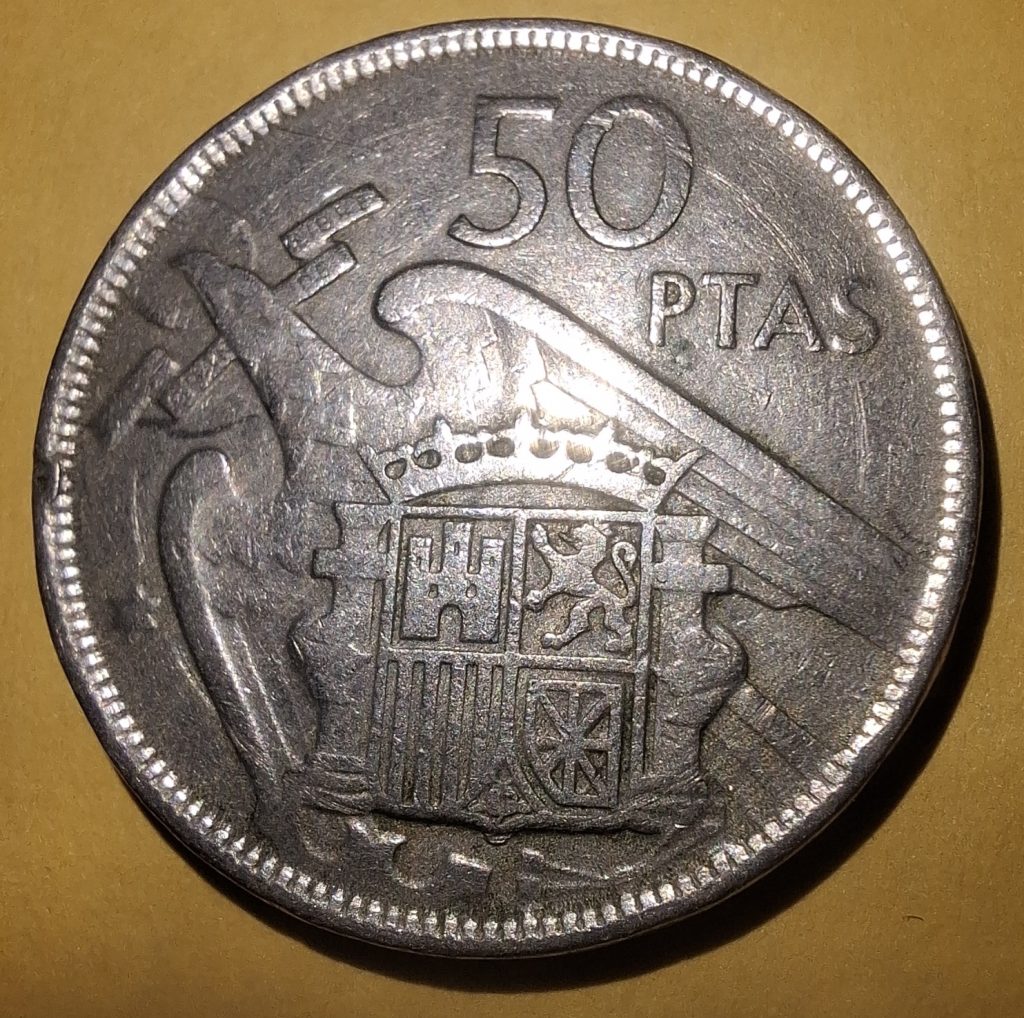
The well-known 1957 50 pesetas coin was issued during the regime of Francisco Franco. On the obverse, it shows Franco’s portrait with the legend “FRANCISCO FRANCO CAUDILLO DE ESPAÑA POR LA G. DE DIOS”; the reverse features the heraldic eagle and shield used under his rule. It was a high-denomination circulation coin at the time, and today it’s a collectible due to its historical context and the existence of many varieties and date combinations (“star dates”).
Technical Specifications
- Face value: 50 pesetas
- Metal: Cupronickel (copper–nickel alloy)
- Diameter: approx. 30.2 mm
- Weight: approx. 12.5 g
- Thickness: ~2.4 mm
- Edge: reeded (milled)
These details are consistent across standard catalogues such as Numista and other numismatic references.
Why It Always Says “1957”
Spanish coins from this era often display two dates:
- the main date (“year of law”) – here 1957, fixed on the design;
- a small date inside a star – indicating the actual year of minting (for example: 1958, 1959, 1971, 1972, 1974, etc.).
So while all coins read 1957, the number in the star reveals when it was truly struck. Collectors use this star date to identify the exact variety.
Varieties and Special Issues
- Different star years: “1957 (58)”, “1957 (59)”, “1957 (71)”, “1957 (72)”, etc. Some are common; others rarer and more valuable depending on the year and condition.
- “BA” / Barcelona variants (Expo 1958): certain special issues bear alternative marks like “BA” instead of the star. These are scarcer and command higher prices.
- Proof and collector strikes: specially minted Proof versions are far more valuable, often commanding premium prices at auctions.
Mintages and Rarity
Exact mintages depend on the combination of main date and star date. Common circulation issues were produced in the tens of millions, while proofs or special varieties were struck in very small quantities. Checking the star date and the coin’s grade is crucial to determine whether a piece is ordinary or rare.
Numismatic Value — What Is It Worth?
(Values are approximate and fluctuate with the market and condition.)
- Heavily circulated coins: very common, usually €1–10.
- Uncirculated or near-uncirculated pieces (FDC): may reach €20–100+, depending on rarity of the star year.
- Proofs and certified rare varieties: can sell for hundreds or even over €1,000 in specialized auctions.
In summary: ordinary circulation coins are worth a few euros, while pristine or rare-star versions can fetch hundreds or more.
How to Evaluate Your Coin
- Read the star date: use a magnifying glass (×10) to identify the year inside the star.
- Assess condition: grades such as circulated, very fine, uncirculated (FDC), or proof. Even small scratches can reduce value.
- Check for cleaning or fakes: overly shiny or scratched surfaces lower the price.
- Compare with catalogs and recent sales: check Numista, NGC, eBay, MA-Shops, or auction houses.
- Consider certification: if your coin seems rare or in top condition, certification (NGC/PCGS) can boost credibility and sale price.
Buying and Selling Tips
- When buying, always request clear photos of both sides and the star.
- When selling, certification is worth it for high-end pieces; for common coins, online marketplaces work fine but yield lower prices.
- Local numismatic clubs and coin shops can offer in-person appraisals.
Conclusion
The 1957 50 pesetas coin is a fascinating piece of Spanish monetary history. Although most examples are common and inexpensive, certain star-date varieties or proof strikes are highly collectible and can command impressive prices. To know what your coin is truly worth, identify the star year, evaluate its condition carefully, and check comparable recent sales.